Walk into any jewelry district in the country right now and you will hear the same argument in two different accents. On one side a salesperson tells you lab grown diamonds are the smart modern buy. On the other side a dealer tells you only a natural diamond is a real diamond. Both of those sentences are marketing. Neither one is gemology.
Here is the part that gets lost. Natural diamond and laboratory grown diamond are both diamond. Both are crystallized carbon with essentially the same chemical composition, crystal structure, hardness, refractive index and dispersion. That is not a lab grown talking point. That is the position of the Gemological Institute of America, and it is why a laboratory grown diamond gets a diamond grading report rather than a simulant report.
What differs is origin, how the crystal grew, what growth features it carries, how rare it is, how it must be disclosed, how the supply behaves, and how the market treats it on resale. Those differences are real and they matter to your money. They just are not the difference between real and fake.
Simulants are a separate conversation
Moissanite is laboratory created silicon carbide. Cubic zirconia is laboratory created zirconium dioxide. Those are simulants. They imitate the look of diamond and they are chemically and optically different materials. A laboratory grown diamond is not in that group. If a seller blurs that line in either direction, you are being handled.
How lab grown diamonds are actually made
There are two commercial growth methods and understanding them helps you read a report.
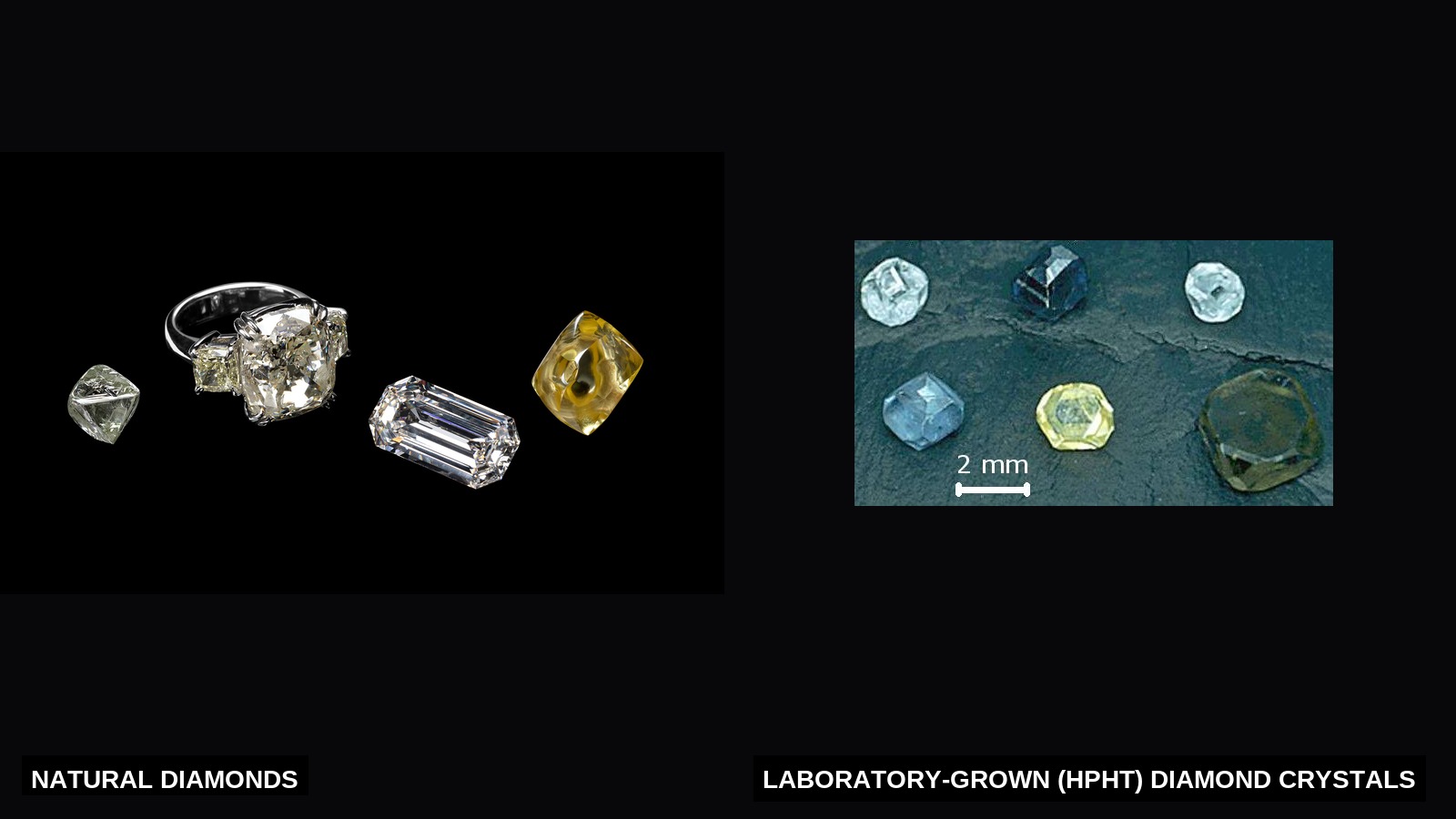
HPHT stands for high pressure, high temperature. A press recreates conditions closer to how diamond forms in the earth. Carbon source material, a metal flux and a small diamond seed are held under extreme pressure and heat, and the carbon crystallizes onto the seed. HPHT crystals often show a cuboctahedral shape and can carry metallic flux inclusions, which is one of the features a laboratory looks for.
CVD stands for chemical vapor deposition. A diamond seed plate sits in a vacuum chamber, a carbon rich gas such as methane is broken down with microwave energy or heated filaments, and carbon builds up on the plate layer by layer. CVD material grows as a tabular plate rather than a crystal with natural faces, and it can carry striations and other growth features from that layered process.
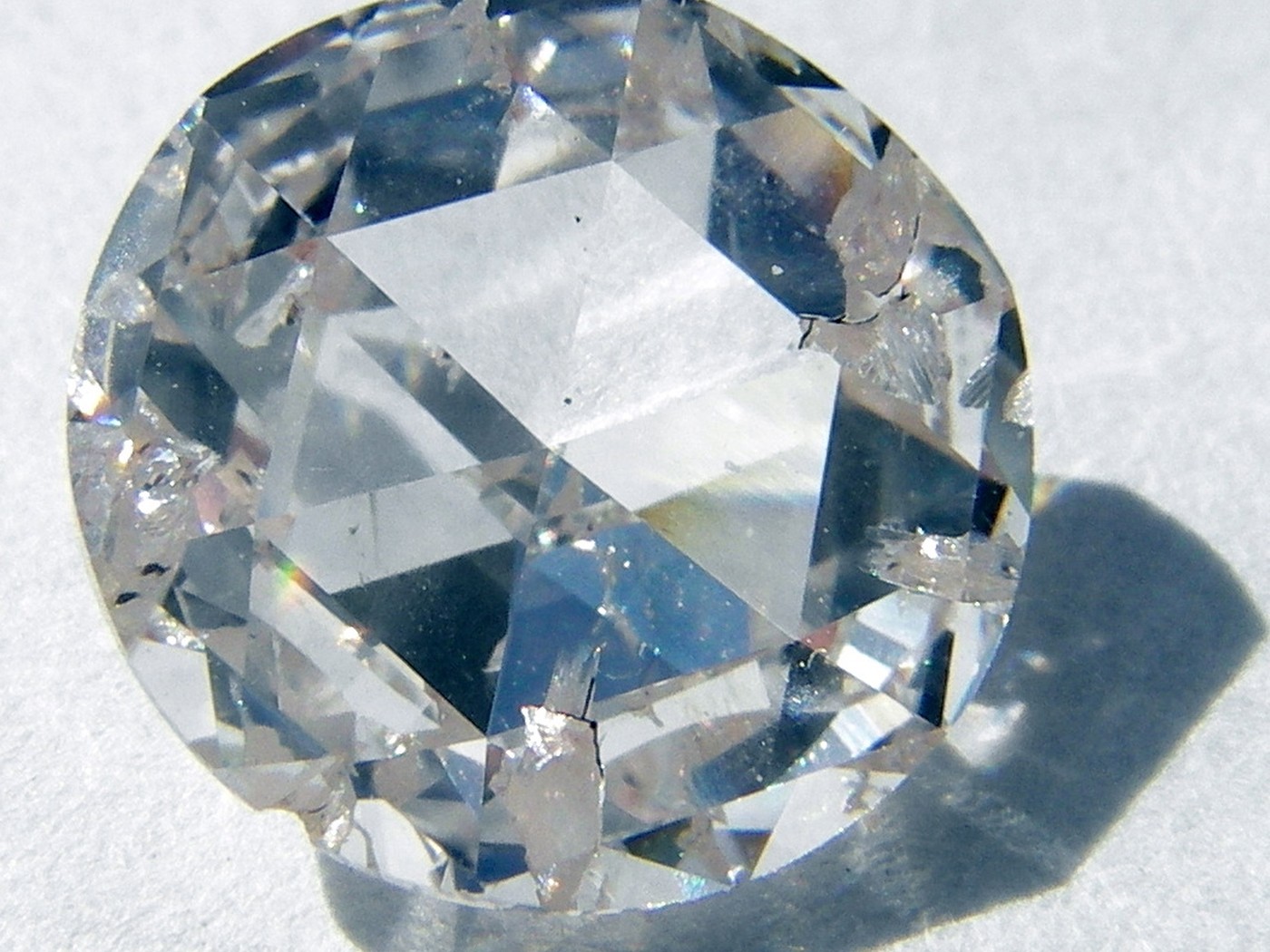
Both methods produce diamond. Both also produce a record of how the crystal grew. A properly equipped laboratory separates natural from laboratory grown using growth structure, fluorescence and phosphorescence patterns, spectroscopy and other instrument based screening. Anyone who tells you the trade cannot tell the difference is not describing a modern gem laboratory. What they usually mean is that you cannot tell with your eye, and that part is true. Your eye is not the test.
Why lab grown prices fell so hard
This is where the emotion in the market comes from. Growth capacity expanded fast, particularly in China and India, reactors got better and cheaper to run, yields improved, and the cost of producing a well cut colorless stone dropped sharply. Manufactured goods behave like manufactured goods. When capacity scales and there is no natural limit on supply, the wholesale price falls, and retail follows with a lag.
That is not a scandal. It is a supply curve. But it has two consequences a buyer should understand. First, a lab grown diamond you buy today is unlikely to hold its price in a falling wholesale market. Second, the retail margin on lab grown can still be very healthy even while wholesale collapses, which is exactly why so many stores pushed into the category.
What buyers are actually buying
Talk to enough clients at the bench and the split is clear.
The lab grown buyer is usually optimizing size, clarity and color for a fixed budget. She wants the biggest, cleanest, whitest stone her money will buy, she wants it to perform in the light, and she is not planning to resell it. For that goal, lab grown is a rational choice and I will say so out loud.
The natural buyer is usually paying for origin. A natural diamond formed in the earth over an enormous span of time, and the supply of good natural rough is finite and unpredictable. There is heritage in that, and there is generally better recognition on the secondary market when a natural stone comes back around with a report. That is not the same as an investment. An ordinary one carat natural diamond bought at retail is not an investment, and any jeweler who sells it to you that way is doing you dirt. Resale on most natural diamonds is a fraction of retail. What natural offers is a market that still knows how to price it.
Be honest about the incentives, all of them
The industry conversation usually stops at consumer preference. It should not.
Many independent retailers and dealers are sitting on natural inventory that was purchased at higher wholesale prices. When natural prices fall, the value of that inventory falls with it, and margins compress on goods that were already paid for. That is a real financial pressure and it is a plausible reason some of the loudest anti lab grown messaging sounds so personal. I am not going to claim, as some posts do, that most jewelers have millions in dead stock. I have not seen data that supports a number like that and neither has anyone repeating it. Inventory pressure is a documented market condition and a credible incentive. It is not a proven motive for every jeweler.
The other side is not neutral either. A store selling lab grown at a strong retail multiple over a collapsing wholesale cost is not doing charity work. Falling production costs can widen retail margins, not shrink them. When someone tells you they only sell lab grown because they care about you, ask what they paid for it.
Neither side of this argument is financially neutral. Ask what the seller paid, not just what they believe.
The sustainability claim needs a sharper knife
Neither material gets an automatic halo. A laboratory grown diamond grown on a coal heavy grid is not automatically the greener choice, and energy sourcing varies enormously between producers. Mining impact and labor conditions also vary enormously by operation and country, and there are large scale operations with serious traceability and community investment programs alongside artisanal production with far weaker oversight. If ethics is your deciding factor, the honest answer is that you need producer level information, not a category level slogan. Ask for the specific mine, the specific grower, and the specific documentation.
What the buyer should ask
Take this list into the store and use it.
- Is this diamond natural or laboratory grown, and is that disclosure in writing on the invoice?
- Which laboratory graded it, and can I see the full report rather than a summary card?
- What is the total out the door price for this exact stone in this exact mounting?
- What is your upgrade policy and your buyback policy, in writing, with the percentage stated?
- If I sold this in five years, what would you personally pay me for it today?
- Am I buying this for how it looks, for what it means, or for what I think it will be worth? Only one of those three answers has a resale expectation attached.
Question five is the one that ends the sales pitch. A dealer bid is the closest thing to an honest number you will get.
Where this goes
I do not think one of these products eliminates the other. The market is splitting into two lanes that serve different needs. Lab grown is becoming the volume lane, where the value proposition is size, performance and accessibility at a falling price. Natural is being pushed toward rarity, provenance, character and larger or unusual stones, where scarcity actually means something and where documentation supports resale.
Both lanes can be sold honestly. A buyer who wants maximum size for the budget and a buyer who wants natural origin and better relative resale recognition are both making a reasonable decision. What is not reasonable is a seller in either lane withholding the disclosure that lets you choose. The Federal Trade Commission jewelry guides exist for exactly that reason, and in the United States that disclosure is not optional.
Ask better questions. Get it in writing. Then buy the stone you actually want.