A GIA Report Is Not a Gold Star
Let’s clear up one of the biggest misunderstandings in diamond shopping: a diamond does not become “good” simply because it has a GIA grading report.
GIA is one of the world’s most respected authorities in gem identification and diamond grading. Its reports are valuable because they provide an independent, standardized description of a diamond. But that document is not an award, a recommendation or a promise that the stone is beautiful.
A low-color, heavily included or poorly cut diamond can still receive a GIA report. The report will simply document those characteristics.
That distinction matters because shoppers often hear “GIA certified” and assume it means “top quality.” It does not. In fact, GIA calls the document a grading report, not a certificate. GIA’s own terms state that a report is not a guarantee, valuation or appraisal. It records the characteristics observed when the stone was examined.
What the Report Actually Tells You
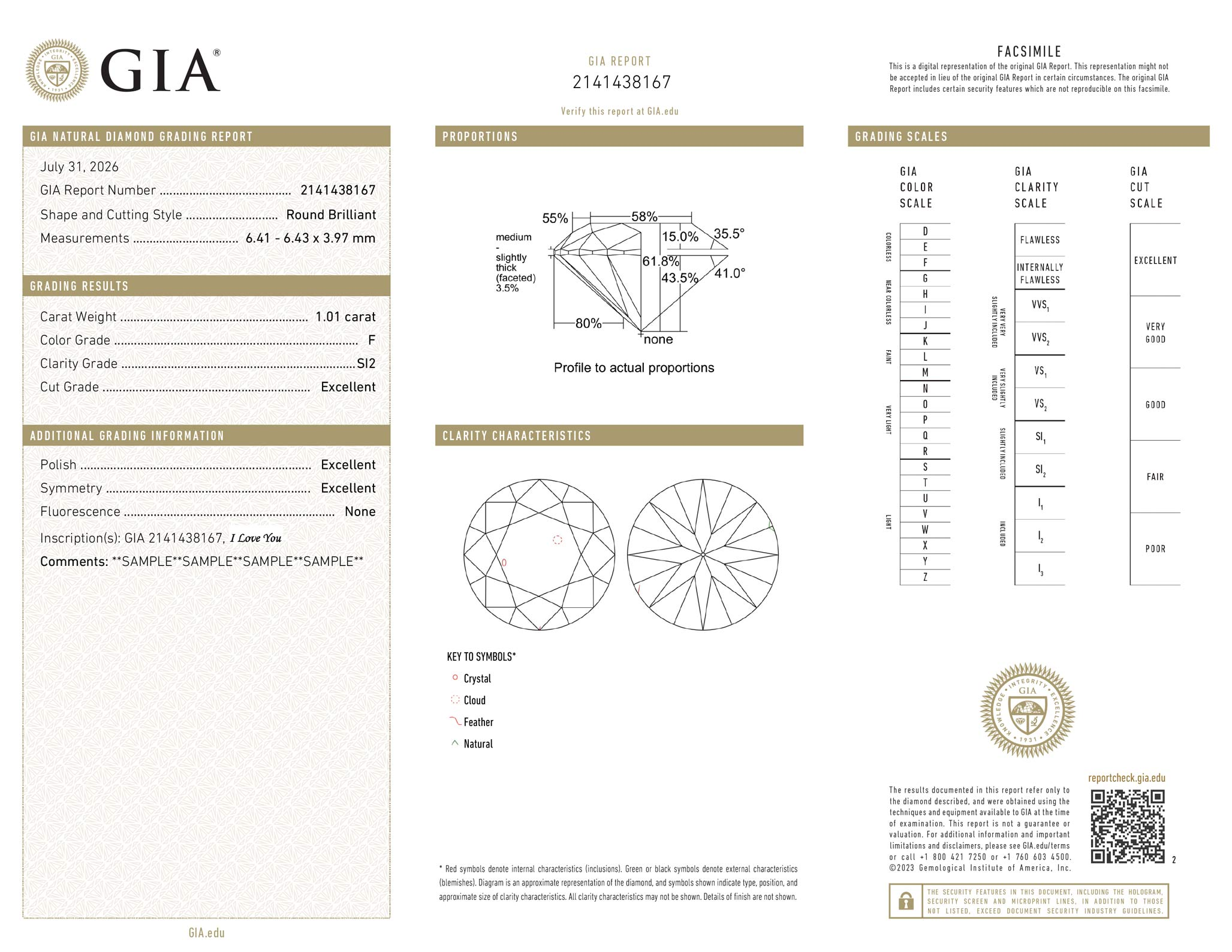
For a loose natural diamond submitted for a full Diamond Grading Report, GIA can document:
- Shape and cutting style
- Measurements
- Carat weight
- Color grade
- Clarity grade
- Cut grade, when applicable
- Polish
- Symmetry
- Fluorescence
- Inscriptions
- Comments and detected treatments
- Proportions
- A plot of clarity characteristics
Those facts are extremely useful. They help identify the diamond, allow buyers to compare stones and give appraisers important information. But facts still require interpretation.
A Report Can Describe a Weak Diamond Accurately
Imagine a round diamond with a low color grade, an Included clarity grade and a Poor cut grade. GIA can examine it and issue an accurate report saying exactly that. The presence of the report does not erase the grades printed on it.
The value is in the accuracy of the description—not in the mere existence of the paper.
The same principle applies to a diamond with an Excellent cut grade. “Excellent” covers a range, and two diamonds with the same basic grades can still look different because of their proportions, facet relationships, inclusions, transparency, fluorescence and overall light performance. The report helps narrow the field, but your eyes and an expert inspection still matter.
Fancy Shapes Require Even More Judgment
Consumers should be especially careful with oval, emerald, pear, marquise, cushion, radiant and other fancy-shaped diamonds. A standard GIA report does not provide an overall cut grade for most fancy shapes.
That means a shopper may see strong color and clarity grades while overlooking a bow tie, poor outline, weak symmetry, windowing, excessive depth or unattractive light return. The report describes the diamond, but it cannot make every aesthetic decision for you.
A GIA Report Is Not an Appraisal
A grading report and an appraisal serve different purposes.
The grading report documents the diamond’s gemological characteristics. An appraisal assigns a monetary value for a stated purpose, such as insurance replacement, estate planning, donation, resale analysis or another specific use.
A report does not tell you whether the seller’s price is fair. It does not tell you what the ring is worth as a finished piece. It does not account for the mounting, craftsmanship, designer, condition or current market in the way a proper appraisal should.
How to Read the Report Before You Buy
Do not stop when you see the GIA name. Read the actual results.
Start with the 4Cs, but keep going. Review polish, symmetry and fluorescence. Study the measurements and proportions. Read every comment. Look at the clarity plot and ask where the inclusions are located. Confirm whether any treatments are disclosed.
Then verify the report number through GIA Report Check and, when possible, compare it with the inscription on the diamond’s girdle. A legitimate report should correspond to the stone being sold.
Most importantly, look at the diamond in different lighting and ask an independent professional to explain what the grades mean in real life.
Why Better Diamonds Are More Likely to Have Reports
There is a reason many people associate GIA paperwork with better diamonds: submitting a diamond for grading costs money and takes time. Sellers are often more willing to grade stones whose value justifies the expense.
That creates an association—but not a rule.
An exceptional diamond may have a GIA report. An ordinary diamond may have one. A visibly included diamond may have one. A poorly cut diamond may have one. And a beautiful diamond may be graded by another reputable laboratory or may not yet have been submitted at all.
The Report Is a Tool, Not the Verdict
A GIA report is one of the most useful tools a diamond buyer can have. It gives you an independent language for understanding and comparing a stone.
But the paper does not shop for you.
A smart purchase combines the report with visual inspection, professional interpretation, price comparison and—when value documentation is needed—a qualified independent appraisal.
The question is not simply, “Does it have a GIA report?”
The better questions are: “What does the report actually say? How does the diamond perform? Is it priced appropriately? And is it the right diamond for me?”