Rolex announced the Four Seasons on September 3. Ten days later, the important question is not whether the watches are loud. They are. The question is why a company known for tight production discipline and quiet institutional control is putting four unique watches into a public auction.
On September 28, Phillips in Association with Bacs & Russo is scheduled to offer the four watches together in London. Rolex says the proceeds will be divided equally between the Roger Federer Foundation, which supports education programs, and Re:wild, the conservation organization associated with Leonardo DiCaprio. This September 13 story is fresh analysis of that confirmed event, not a claim that Rolex announced a new release today.
Four seasons, four material stories
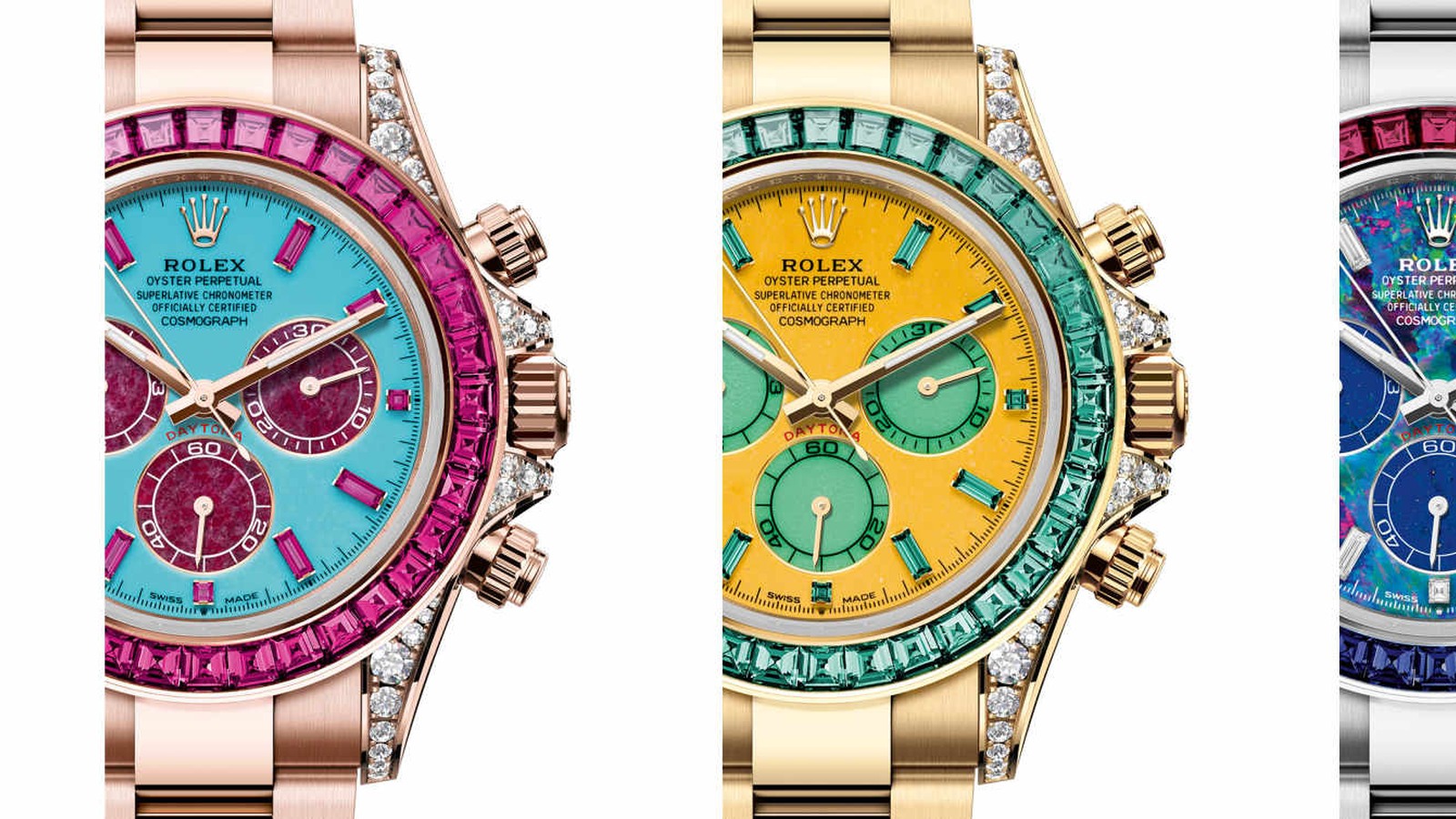
Each watch is a unique 40 mm Cosmograph Daytona. Spring is executed in 18 ct white gold with a chrysoprase dial, lepidolite counters, purple sapphire hour markers, a bezel set with 36 trapeze-cut purple sapphires and 54 brilliant-cut diamonds across the case shoulders and crown guard. Summer uses 18 ct Everose gold, a turquoise dial, ruby counters, pink sapphire markers, a 36-stone pink sapphire bezel and the same 54-diamond case treatment.
Autumn shifts to 18 ct yellow gold, a mookaite dial and chrysoprase counters. Green tourmalines form the hour markers and 36-stone bezel. Winter uses 950 platinum with a blue opal dial, lapis lazuli counters, diamond hour markers and a bezel of 36 sapphires graduating from blue into fuchsia. Its case is also set with 54 diamonds.
Those specifications are extraordinary, but the lists alone do not explain the craft. A lapidary has to cut ornamental stone thinly enough for a dial while preserving color and avoiding fractures. A setter needs calibrated stones to follow a circular bezel cleanly. Baguette and trapeze cuts advertise alignment errors more readily than a field of small rounds. The visual transition must read as a season, not as a random inventory tray.
Why the set feels unlike ordinary Rolex
Rolex makes gem-set watches, colorful dials and Daytonas in precious metals. The unusual part is the combination of four one-of-one pieces, a named artistic concept and a public sale directly connected with the brand.
The Crown generally builds value through repeatable references, controlled distribution and gradual evolution. Unique watches reverse that logic. There is no production reference against which a collector can compare availability, and no second Four Seasons set waiting at another authorized dealer. Public auction also exposes demand in a way a private allocation does not.
That transparency matters. A retail price tells us what the maker asks. A dealer listing tells us what a seller hopes to receive. An auction result tells us what at least two bidders were willing to contest on a particular day, before buyer’s premium is interpreted. Those are different numbers, and responsible watch reporting should not collapse them into one.
The rarest thing here may not be the gemstones. It may be Rolex choosing a public room to let demand speak.
Gem setting is design, not decoration
As a jeweler, I look past the total number of stones and ask whether they carry the idea. Here they do. Spring’s purple and green, Summer’s turquoise and pink, Autumn’s earthy mookaite and green, and Winter’s blue-to-fuchsia transition create four distinct temperatures without abandoning the Daytona architecture.
The dials also carry natural variation. Chrysoprase, turquoise, mookaite, opal, lepidolite and lapis lazuli are not printed colors. Their texture and pattern are part of the material. Cutting several dial components that look intentional together requires selection, orientation and restraint. A beautiful slab can still be wrong for a subdial. A dramatic vein can interrupt legibility. That editing is where jewelry judgment enters watchmaking.
None of this makes every gem-set watch tasteful by default. Gem setting can overwhelm a case or turn a functional scale into noise. These watches invite that debate. They also show that Rolex treated color as a system across dial, counters, markers and bezel instead of simply adding diamonds to an existing reference.
The charity purpose changes the room
Rolex states that the proceeds will be split evenly between the Roger Federer Foundation and Re:wild. The first works to improve access to quality education for children in Southern Africa and Switzerland. The second supports biodiversity and conservation efforts.
Charity auctions can produce bidding behavior that ordinary market comparisons do not capture. A bidder may value the philanthropic purpose, the access surrounding the sale or the symbolic importance of the set alongside the watches themselves. That does not make the result less real. It does make it a specialized result that should not automatically be used to reprice every gem-set Daytona in a dealer’s case.
About those auction-record predictions
Independent coverage has already raised the possibility of a major record. Excitement is understandable. Rolex rarely presents unique contemporary watches this way, the Daytona is an established collector category, and four pieces form a coherent set. None of that is a hammer price.
Until Phillips closes the bidding, there is no confirmed buyer, final bid or record. Currency conversions, buyer’s premium and whether the set is compared with a single-watch record will also matter to any later headline. I would rather wait for the invoice than appraise the applause.
Collectors should also resist using this sale as a guarantee for other watches. Provenance, condition, reference, originality, timing and the competitive depth of one room all affect auction performance. A charity result for four unique watches is not a retail forecast for a production Daytona.
Conclusion: unusual by design
The Four Seasons matter because Rolex has combined gem-setting ambition, one-of-one status, public price discovery and a charitable purpose in one event. The watches demonstrate serious color work and difficult setting, but their larger significance is institutional. Rolex is allowing four unique contemporary pieces to become visible, contestable and documented in public.
On September 28, the market will supply a number. Until then, the verified story is already strong enough: four unique Daytonas, four carefully constructed seasonal palettes and one unusually open moment from the Crown.