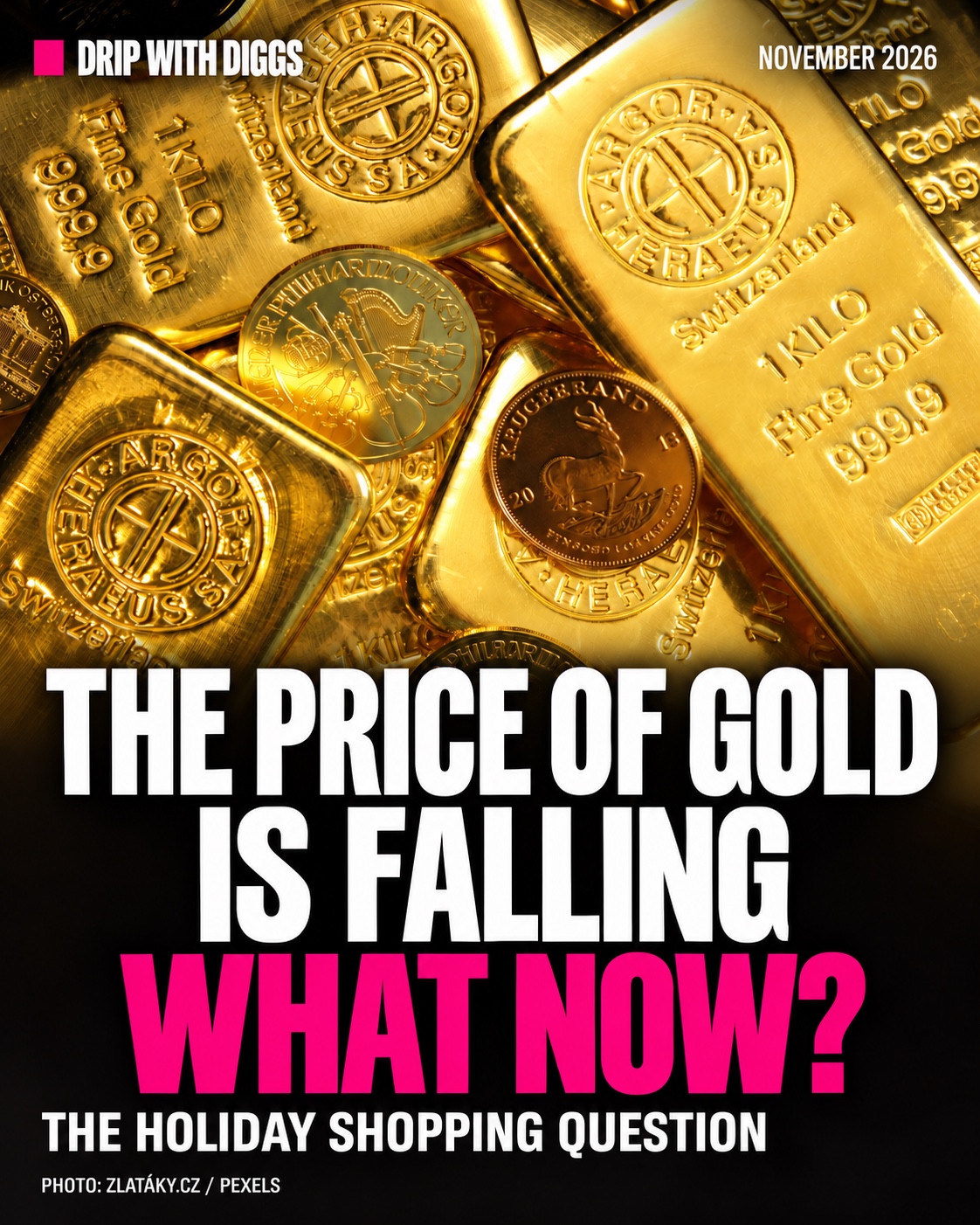
Gold was back below $3,900 an ounce before the holiday shopping rush, a sharp reversal from the record reached in January. For anyone who has watched the price of a chain, bracelet or custom piece climb, the immediate question is practical: does this finally create room to buy?
At 2:05 p.m. Eastern on Friday, November 13, Reuters put spot gold at $3,879.71 per troy ounce. That was roughly 4.5% lower for the week at that point. Thursday alone brought a 3% slide. Friday's small rebound did not undo it.
The figures describe the international dollar-priced bullion market, not a sale at a jewelry counter. They are Friday's reported snapshot, not a live Saturday quote. But the move is substantial enough to matter to the people buying metal, making jewelry and deciding what they can afford to give.
The rise began before this election
Gold's ascent did not begin with the November 2026 midterms, or with the start of President Donald Trump's second term.
The World Gold Council's review of 2024 shows a 25.5% annual increase in the dollar-denominated LBMA afternoon benchmark. That was a year largely under President Joe Biden, before Trump returned to office in January 2025.
The advance accelerated. In its 2025 demand review, the council reported a 67% rise in the dollar gold price and 53 record highs in the LBMA afternoon benchmark. Investment demand was central: gold-backed exchange-traded fund holdings increased by 801 tonnes, while central banks bought 863 tonnes. The council identified demand for safety and diversification alongside buying encouraged by the price's own momentum.
Those buyers were not all making the same political bet. A central bank managing reserves, a fund adjusting its portfolio and a customer buying coins have different reasons to own gold. Together, their demand can push the same market higher.
On January 29, 2026, spot gold reached $5,594.82 an ounce. Qatar News Agency's contemporary report recorded that peak and a retreat later that day as investors took profits. The reversal was already part of the story on the day of the record.
Compared with that intraday high, Friday's $3,879.71 snapshot was $1,715.11 lower, a decline of approximately 30.66%. That is a peak-to-snapshot calculation across more than nine months, not a one-day loss. The 2024 and 2025 benchmark returns describe separate annual periods; they should not be mistaken for the return between those two spot quotes.
A steep fall, not a straight line
The timing matters as much as the size. Gold did not simply hit January's record and move lower every day thereafter.
The World Gold Council's November 9 market monitor reported that the LBMA afternoon price had recovered 3.5% in the week ended November 6, finishing at about $4,050. The following week's selloff reversed the direction again.
That sequence is the warning against treating a lower price as a permanent new price. A rebound can arrive inside a larger decline, and a sharp fall can follow a week that appeared to be stabilizing.
The latest pressure was tied to inflation and the interest-rate response. Reuters linked Thursday's decline to higher oil prices and concern that inflation would keep rates elevated, following hotter-than-expected consumer-price data. Friday's producer-price report offered some relief, but not enough to restore the week's losses.
Why inflation can send gold down
Gold has a reputation as an inflation hedge. That does not mean every hotter inflation report sends its price up.
When inflation raises expectations for higher interest rates, investors reassess the return available from assets that pay interest. Gold pays no coupon. Holding it can become less attractive relative to those alternatives. Reuters' November 13 report identified that interest-rate pressure as a central problem for bullion.
This is why the same headline can pull the market in competing directions. Concern about purchasing power can encourage gold buying, while the prospect of tighter monetary policy can discourage it. The result depends on which force dominates at that moment.
A gold-price chart is therefore not a simple meter of how worried everyone feels. It also reflects the cost of holding gold instead of something else.
Did the Democratic victory cause the drop?
The immediate election reaction ran in the opposite direction.
Democrats won majorities in both chambers in the November 3 elections and are preparing to take control of Congress in January, according to Reuters' November 13 congressional reporting. That is a change in the incoming Congress, not a change of president.
The World Gold Council's November 9 monitor said the Democratic sweep initially helped lift gold as investors reconsidered spending, regulation and foreign policy. It also said the initial reaction had faded and expectations for the Federal Reserve's policy path remained the key driver.
So the November selloff cannot accurately be reduced to “Republicans lost power, and gold fell.” Gold first received a lift around the result, then faced a different set of pressures from inflation and rates.
Policy still matters. The incoming Democratic majority has discussed addressing tariffs, healthcare costs and the Iran war. But proposed legislation is not enacted legislation, and a congressional majority does not automatically deliver its agenda. Reuters noted the Senate's usual 60-vote hurdle for advancing most legislation.
The same distinction applies looking backward. Gold's rally overlapped with Republican control, but overlap is not proof that one party alone caused it. The advance was already underway in 2024, and the documented demand came from investors and central banks across the world.
Is a cheaper ounce a sign of recovery?
Not on its own.
The World Gold Council's November 9 assessment described resilient US labor markets and business activity alongside persistent inflation. Stronger activity can support confidence while also making it harder for policymakers to ease interest rates.
For a household, “recovery” has a more concrete meaning: income that stretches further, manageable borrowing costs and essential expenses that stop outrunning the budget. A lower bullion quote does not settle those questions.
It can ease one input cost for jewelry. It does not establish that groceries, rent, energy and financing have all become affordable. Nor does it tell us that the political changes will produce a particular economic outcome.
What the drop means at the jewelry counter
The metal calculation is useful when it is kept in its lane.
According to the World Gold Council's purity guide, a troy ounce equals 31.1034768 grams. Nominal 14K gold contains fourteen parts gold out of twenty-four; 18K contains eighteen.
Consider a hypothetical piece containing 20 grams of nominal 14K alloy, with no stones included in that weight. A $100 decline in the price of an ounce changes its theoretical contained-gold value by about $37.51. For 20 grams of 18K alloy, the same market move changes that value by about $48.23.
These are calculations of the gold component, not retail discounts. They leave out the value of other alloy metals, design, fabrication, setting, stones, overhead and profit. An actual 585-marked alloy also has slightly more gold than the exact fourteen-out-of-twenty-four calculation.
Jewelers of America explains that karatage, weight and craftsmanship all contribute to jewelry pricing. A labor-intensive custom design and a straightforward chain will not respond identically to the same bullion move.
For a fuller breakdown, our September guide examines why a lower spot price does not automatically lower a finished jewelry price.
Christmas and New Year's are deadlines, not forecasts
There is no dependable promise that gold will stay at this level through Christmas or New Year's. Softer inflation and reduced rate pressure could change the balance; renewed inflation pressure could work against bullion. Neither is a calendar guarantee.
For a gift purchase, the more useful protection is a clear agreement with the seller. Ask how long a written quote remains valid, what locks the price, whether a deposit is refundable, and what delivery date the jeweler will commit to. A lower metal price is not useful if a custom piece misses the occasion.
Compare like with like: karat, metal weight, solid or hollow construction, workmanship and the total delivered price. The Federal Trade Commission recommends checking the seller and getting refund and return policies in writing. That matters particularly when shopping for someone else, who may need a different size or decide the piece is not right.
Buy within a budget that works at the quoted price, rather than borrowing on the assumption that gold must rise again or waiting on the assumption that it must fall further.
The market has created a different starting point from January's peak. Whether it creates a good holiday purchase depends on what the jeweler puts in front of you: the piece, the workmanship, the price and the terms. Those are things a buyer can evaluate now.
About the author
Erica Diggs is a GIA Graduate Gemologist, bench jeweler, and founder and editor of Drip With Diggs, covering jewelry, craftsmanship and the business behind what we wear.
SOURCES
- Reuters via MarketScreener: November 13 gold prices and interest-rate pressure.
- World Gold Council: December 2024 market commentary.
- World Gold Council: Gold Demand Trends, full year 2025.
- Qatar News Agency: January 29, 2026 record and reversal.
- World Gold Council: Weekly Markets Monitor, November 9, 2026.
- Reuters via Investing.com: Incoming congressional majorities and 2027 agenda.
- World Gold Council: November 9 economic assessment.
- World Gold Council: Gold jewelry, purity and troy-ounce conversion.
- Jewelers of America: Gold-jewelry buying guide.
- FTC: Buying platinum, gold and silver jewelry.