Two stones. One lot. No reserve. That last part is what made me sit up.
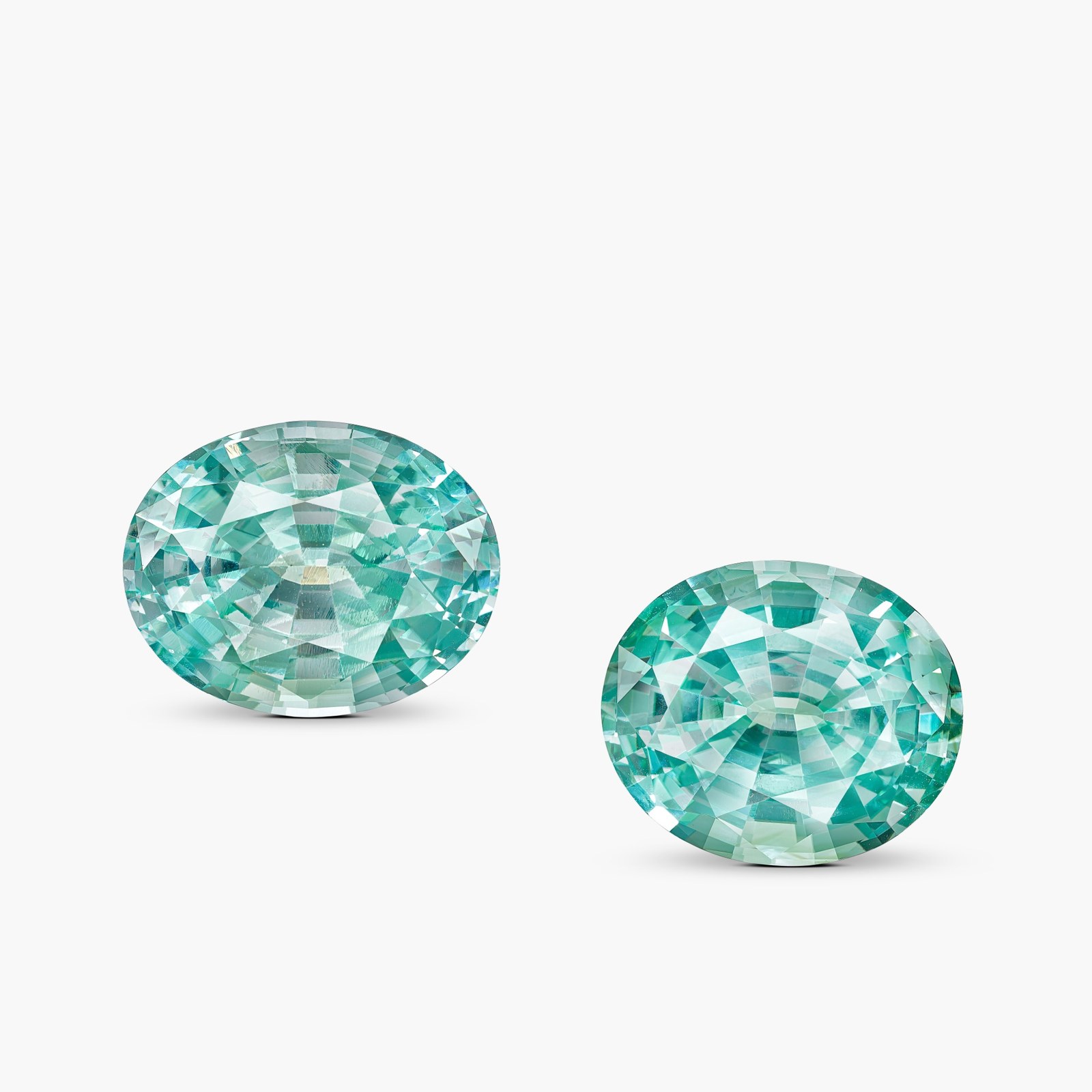
Sotheby's is offering the Kat Florence Luminas, a pair of unmounted oval Paraiba-type tourmalines weighing 71.24 and 72.84 carats, as lot 1677 in its High Jewelry sale in Hong Kong. The live auction begins on September 17. Together the pair comes to 144.08 carats.
What the lot actually says
According to the Sotheby's lot description, both stones carry Gubelin Gem Lab reports. Report number 26071026, dated July 16, 2026, covers the 71.24 carat stone as Paraiba-type tourmaline from Mozambique with a Gem Rating card score of 92.1, described as outstanding. Report number 26071027, dated July 21, 2026, covers the 72.84 carat stone as Paraiba-type tourmaline from Mozambique with a score of 90.6, also described as outstanding. The lot also includes a certificate of authenticity from Kat Florence and an additional gemmological report referenced in the condition report.
The published estimate is HKD 3,000,000 to 4,000,000. The Hong Kong dollar is pegged in a narrow band against the U.S. dollar, so at roughly 7.8 to the dollar that estimate translates to approximately $385,000 to $515,000. Treat that as an approximate conversion, not a quoted figure, and note that it is lower than the U.S. number attached to some coverage of this lot. Sotheby's publishes the estimate in Hong Kong dollars, so that is the figure I trust.
Kat Florence describes the pair as the largest matched pair of flawless, unheated Paraiba tourmalines ever offered at auction. That is the designer and consignor speaking about her own lot. It may well be accurate, but it is a claim, not a record certified by anyone outside the sale.
There is also a bid showing on the lot page, and it will keep moving. A bid is not a price. Neither is an estimate. The only number that means anything is a hammer price after the sale closes, and the lot has no reserve, which means it can legally sell for whatever the room and the phones decide.
What Paraiba-type actually means
This is where buyers get taken, so it is worth being precise.
Paraiba tourmaline was first found in the Brazilian state of Paraiba in the 1980s. What set it apart was not simply blue color but the cause of that color, copper, sometimes with manganese. Copper-bearing tourmaline glows in a way ordinary blue tourmaline does not. It reads as electric under almost any light.
Then copper-bearing tourmaline turned up in Nigeria and, most importantly for the market, in Mozambique. The trade needed language for material with the same chemistry from a different place. The result is the term Paraiba-type, which describes copper-bearing tourmaline regardless of country of origin. A Mozambique stone can absolutely be called Paraiba-type. What it cannot be called is Brazilian.
Origin still moves price. Brazilian material carries a premium built on history and on the mines being largely worked out. Mozambique material is where the large clean stones come from, and it is the reason a pair like this exists at all. Nobody was cutting matched seventy carat ovals out of the original Paraiba deposits.
A laboratory report matters here more than it does for many gems, because you are paying for the copper and for the country. Gubelin's Gem Rating adds a second layer, scoring the stone on qualities that a plain identification report does not grade. Scores in the low nineties described as outstanding are strong. They are also a lab's assessment on a lab's scale, not a universal grade like a diamond color letter.
Why matching is the hard part
People hear 144 carats and think size is the story. Size is the easy story.
Cutters chase weight because weight pays. What almost nobody sets out to do is produce two stones that agree with each other, because agreeing costs weight. To match a pair you have to control several things at once.
Hue and saturation have to line up. Copper-bearing tourmaline runs from greenish blue to almost pure neon blue depending on the pocket, and two stones from the same parcel can still read differently. Tone has to line up, meaning one cannot be visibly lighter than the other. Extinction has to line up, which is the pattern of dark windows a stone shows when you rock it, and at this size a poorly proportioned oval will show a hollow center that its partner does not. Outline and proportion have to line up, so they read as siblings rather than cousins. And they have to hold that agreement across daylight, showroom light and photography.
Now add scale. Cut a seventy carat oval and every inclusion, every color zone and every millimeter of depth is magnified. Finding two rough pieces from the same region, cutting both to a compatible outline, and ending up with a pair that stays matched in the hand is a genuinely small-numbers event. That is the rarity in this lot, more than the total carat weight.
The design dilemma
Here is the honest tension, and it is a real one for whoever buys these.
Kept together, the stones are earrings or a pair of statement rings, and they hold a story you cannot reconstruct. Split apart, each stone is easier to sell, easier to finance and easier to set, because a single seventy carat centerpiece can go into a necklace, a cocktail ring or a cuff without needing a partner to agree with it.
Splitting is not vandalism. But it is irreversible in economic terms. You can always separate a matched pair. You can almost never reassemble one, because you would have to find another stone that matches on hue, tone, saturation, extinction and outline at seventy carats, and the reason this lot is notable is that such stones are not sitting in a drawer waiting.
If I were setting them, the pair reads best as pendant earrings where the two stones hang at the same height and a viewer can compare them directly, with minimal metal and small colorless diamonds carrying the color rather than competing with it. Copper-bearing tourmaline has a hardness in the seven to seven and a half range with brittleness at the edges, so protective settings and thoughtful girdle coverage matter more than they would with sapphire. Whoever mounts these should also assume the owner will want them checked and cleaned by hand, not dropped in a machine.
The takeaway
Watch this lot for the matching, not the total weight. And when the sale closes, look at the hammer price and ignore every number published before it, including the estimate and every conversion of it.
Then ask yourself the only question that really matters here. If you owned them, would you keep them together?