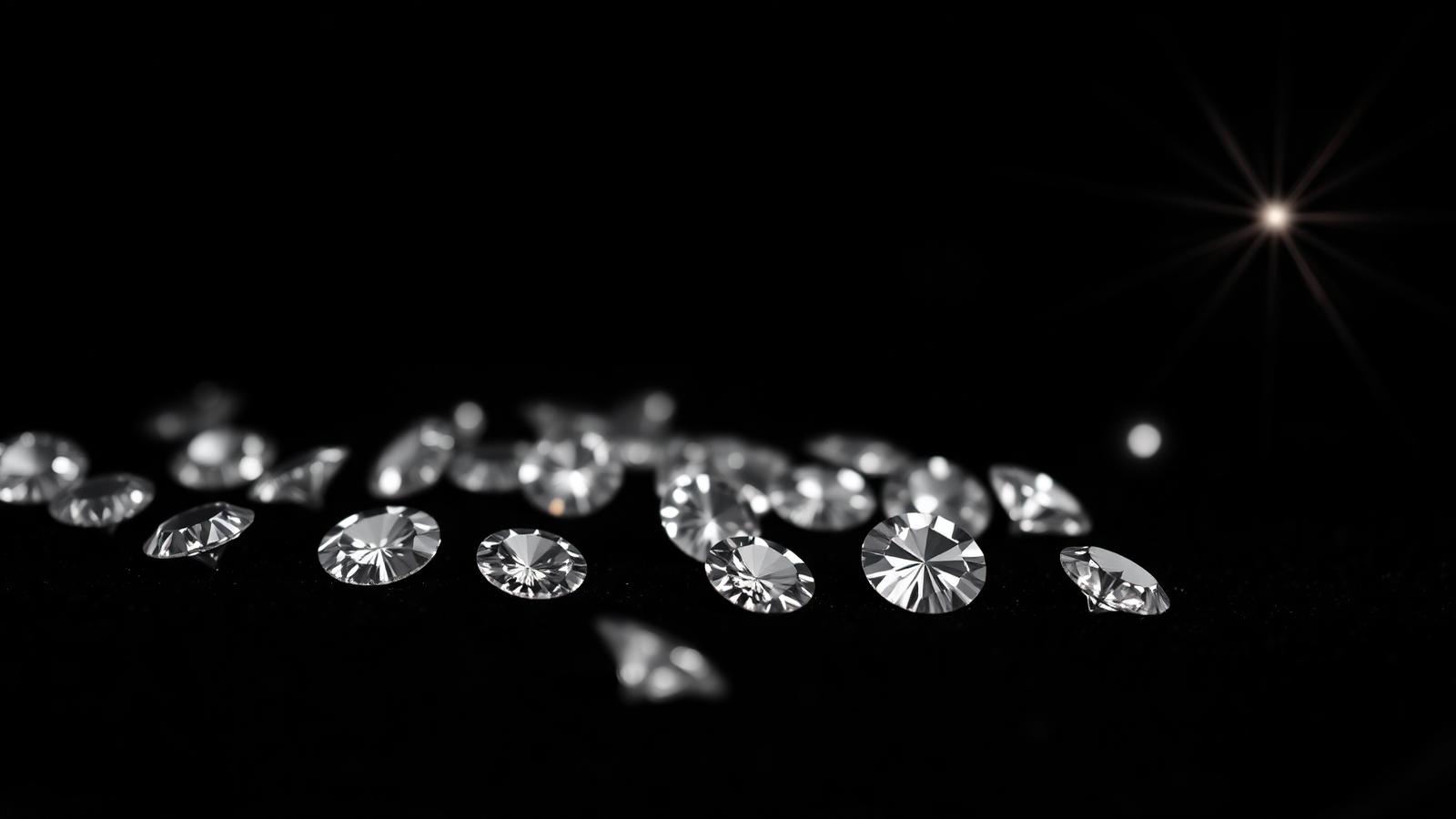
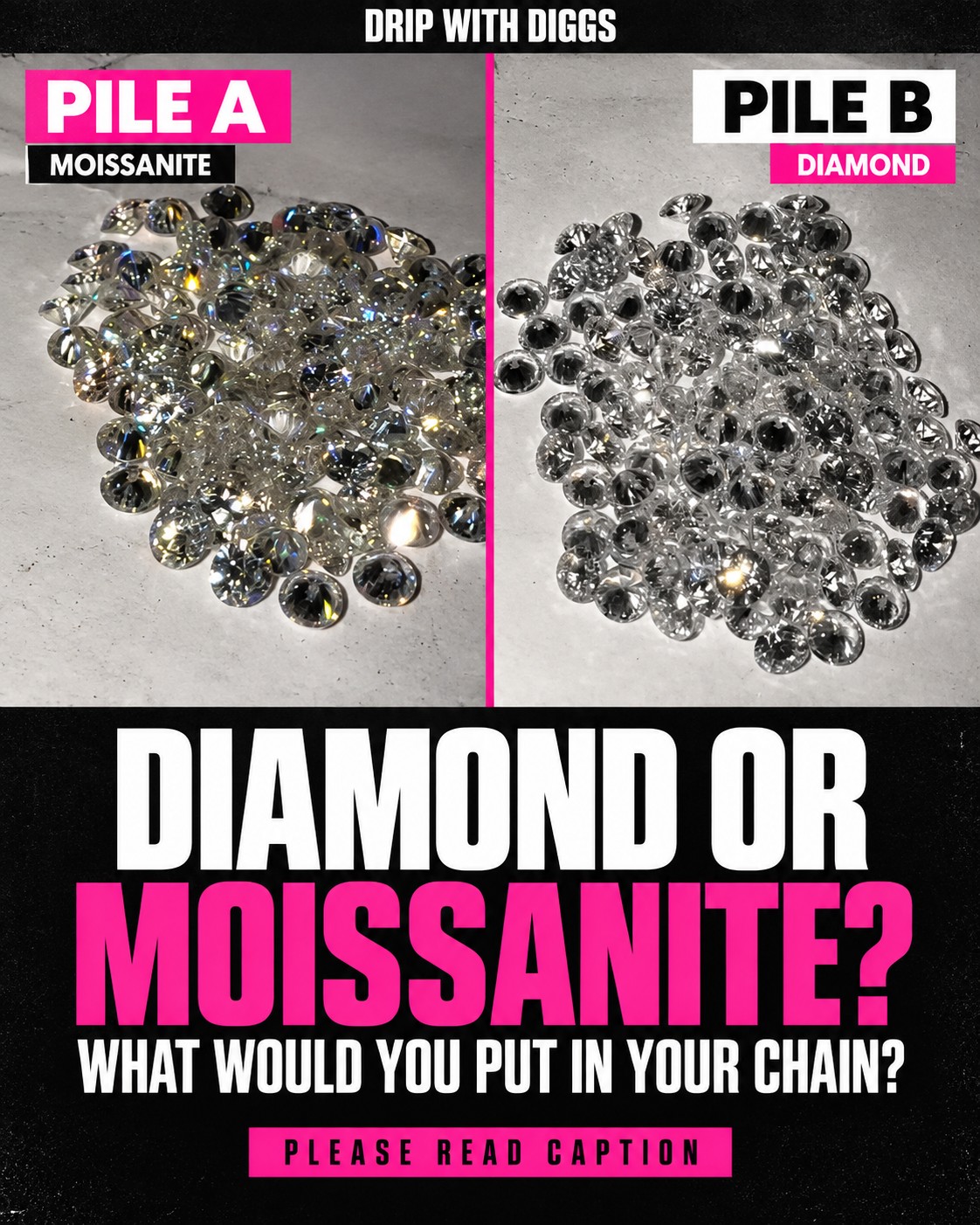
Pile A was moissanite. Pile B was diamond.
Both parcels in the original comparison were described the same way: 25 carats total, 4 mm round stones, filmed under the same light. No filter tricks, no separate setups, no staging one pile to win. Just two piles and one question.
I did not post that comparison to shame anyone for what they buy. I posted it because the jewelry business has a disclosure problem, not a taste problem. Diamond and moissanite are two different materials with different optical behavior, different pricing and different meaning to the person wearing them. A buyer who knows exactly which one is in their chain is a happy client. A buyer who finds out later is a client I inherit, usually angry, usually holding a receipt that says nothing useful.
Watch the original comparison
If the embed does not load for you, watch the comparison on Instagram.
What your eyes are seeing
Moissanite has higher dispersion than diamond. Dispersion is a material's ability to split white light into spectral colors, and in practice it is why moissanite so often reads as stronger rainbow flash, the thing the trade calls fire. Under a bright point light, a parcel of moissanite can throw noticeably more color than a parcel of diamond sitting beside it.
Diamond behaves differently. Diamond gives you its own balance of brightness, fire, scintillation and the pattern of light and dark contrast that a well cut stone produces as it moves. That contrast pattern is part of what trained eyes read as diamond, and it is the part video flattens the most.
Here is the honest caveat, and it matters more than the reveal. Whichever pile looks louder on your phone is not scientifically the better stone. Video exposure and white balance change everything. So does focus, the angle of the light, cut quality, cleanliness and simple variation between individual stones in a parcel. A comparison like this is a teaching tool for your eyes, not a laboratory test and not a verdict.
Diamond and moissanite are not the same material
Diamond is crystalline carbon. Most jewelry moissanite is laboratory created silicon carbide. Those are two different chemical species, and no amount of marketing language collapses that difference.
This is the point where the vocabulary gets abused, so let me be blunt. Moissanite is a diamond simulant. It is made to look like diamond. It is not a laboratory grown diamond. A laboratory grown diamond is still diamond, carbon, and it is graded and sold as diamond with the growth method disclosed. Moissanite is a separate material entirely. Anyone selling you moissanite as a lab diamond is either confused or lying, and both cost you money.
Both materials can be durable and both can look beautiful in the right setting. What they cannot be is interchangeable on an invoice.
Do the Four Cs apply to both?
Careful here, because this is one of the most common pieces of misinformation in jewelry content.
GIA's Four Cs, cut, color, clarity and carat weight, are the international standard for communicating diamond quality. That system was created for diamond. It is not a universal grading system that GIA applies to every gemstone, and GIA does not issue a standard diamond grading report for moissanite.
What you can do with any stone, including moissanite, is observe. Look at cut quality and symmetry. Look at apparent color face up. Look at transparency and whether the stone reads clean to the eye. Get the measurements in millimeters and the weight in writing. Those observations are useful and you should make them.
What those observations are not is a substitute for a GIA diamond grade. If a seller hands you a moissanite and starts quoting a color and clarity grade as if it came off a diamond report, ask what laboratory issued it and what the document actually says.
Carat weight is not face-up size
Carat is a unit of weight, not a unit of spread. This trips up more buyers than any other concept in the shop.
A 4 mm diamond and a 4 mm moissanite can face up at a similar diameter, because diameter is a measurement of the stone's outline. They will not necessarily weigh the same, because the two materials have different densities. Same footprint, different scale reading.
Each parcel in the comparison was described as 25 carats total. That is the fact I can stand behind. I am not going to tell you both piles held the same number of stones, because the video does not prove that and density alone makes it unlikely. If you are shopping by look, shop by millimeter and by coverage. If you are shopping by value, get the weight and the material both stated in writing.
What should go in your chain?
Choose diamond if you want diamond specifically. If the material identity matters to you, if you want grading documentation where it applies, if you want that particular optical character and the resale and appraisal conversation that comes with a graded natural or lab grown diamond, then buy diamond and pay diamond money.
Choose moissanite if you prefer that stronger rainbow fire, if you want more visual coverage for your budget, and if you know and accept that you are buying moissanite. That is a legitimate purchase made by adults with clear eyes. Nobody needs to apologize for it.
For either one, the non negotiables are the same:
- Written disclosure of the material on the invoice, in plain words.
- Metal quality stated, karat or fineness, not just a color.
- Setting craftsmanship you can inspect, clean prongs or bezels, no lifted stones.
- Stone security, because a loose stone is a lost stone regardless of what it is made of.
- Repair expectations, including who covers a stone that falls out and when.
- An itemized receipt, not a total scribbled on a card.
That list is the whole game. The stone is a choice. The paperwork is a protection.
So tell me straight. What would you put in your chain: diamond or moissanite?