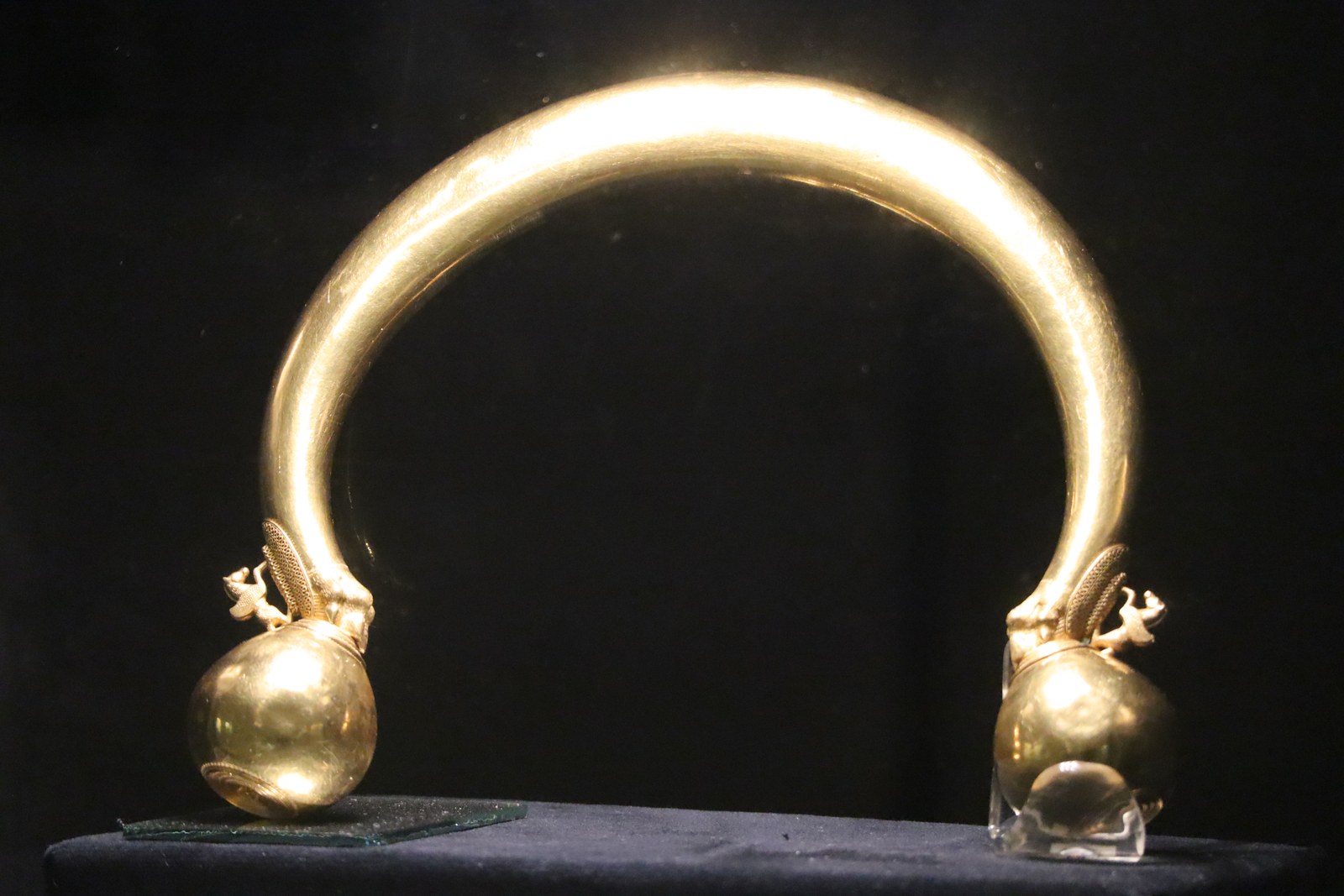
Four minutes. That is roughly how long it took, in July, for thieves to walk out of the Musee du Pays Chatillonnais in Chatillon-sur-Seine with a gold necklace weighing nearly half a kilogram and dating back about 2,500 years.
The Associated Press published a trend report on September 10 examining ten museum burglaries across France and elsewhere in Europe during the summer of 2026. Eight of them went after jewelry, coins, gold or other valuables that can be broken apart or melted down. Read that ratio twice, because it explains the whole pattern.
What the summer looked like
The Chatillon-sur-Seine theft is the one that stays with me, and the photograph at the top of this story is the object itself, on its stand, before it was gone.
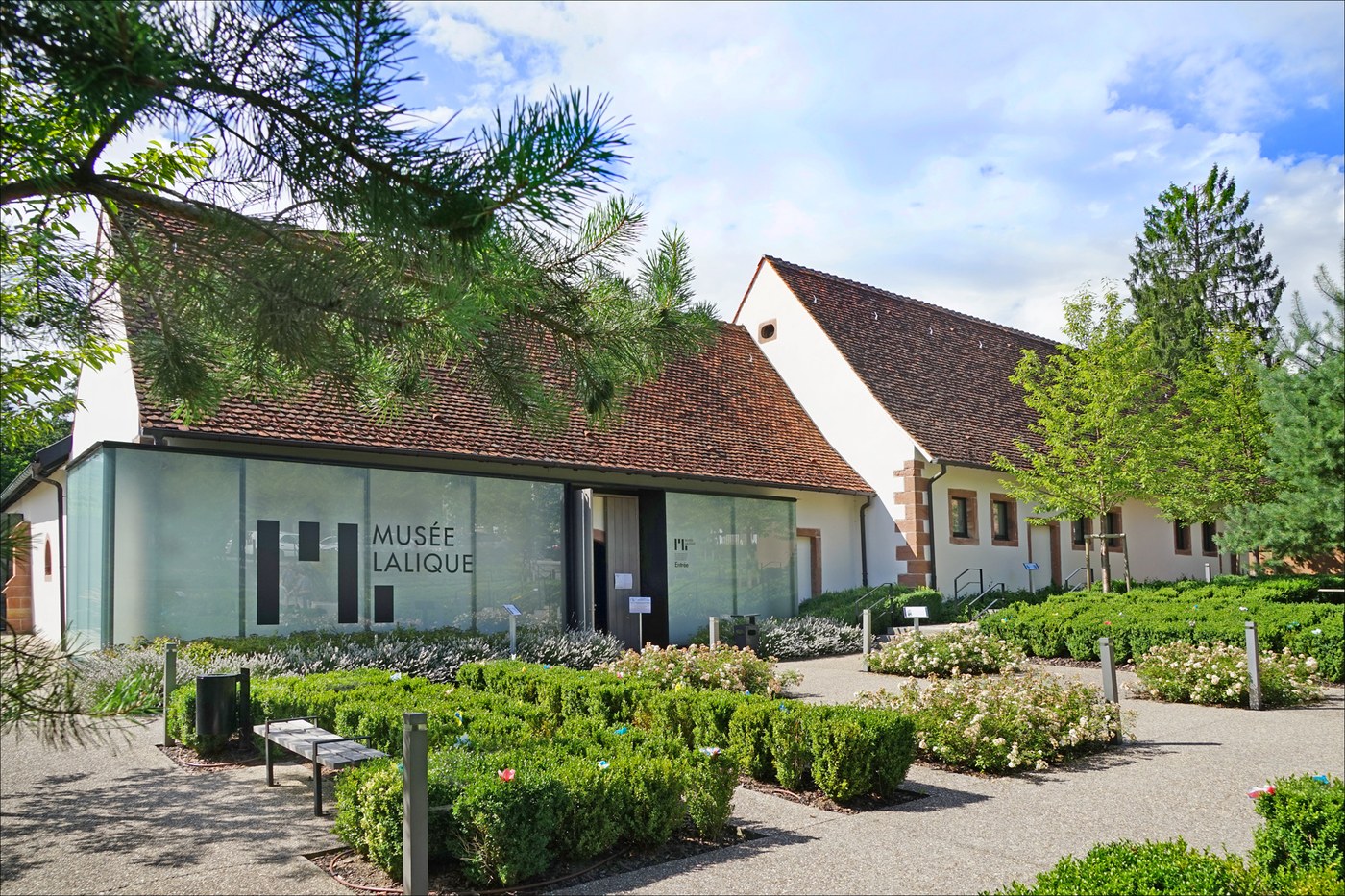
Another July robbery reported in the AP package involved 27 pieces of jewelry valued at more than 4.5 million euros. The Lalique Museum has been closed since a burglary on July 5 while it seeks roughly 200,000 euros in security upgrades, which is a small figure next to what was lost and an enormous one for a regional museum budget.
Reuters reported in August that Europol warned museum heists have become more violent, and that some of the people carrying them out are recruited through social media. That second point is the one security professionals find most difficult. It means the crew standing in the gallery may have no criminal history, no connection to each other, and no idea who hired them.
Then, on September 8, The Guardian reported a theft from the Renoir Museum in Cagnes-sur-Mer on the French Riviera. Two thieves cut through the museum's garden fence and took Renoir paintings, and it is thought they dropped two of the four artworks in the garden as they fled.
That last case is a useful place to draw a line. It was paintings, not jewelry. Not every incident in this wave involved jewelry, and lumping paintings in with gold blurs the very thing that makes the jewelry cases distinct. A stolen Renoir is unsellable and instantly recognizable. A stolen gold torque is neither of those things once it stops being a torque.
Why a museum, and not a jewelry store
I have spent my working life on the retail and bench side of this trade, and the comparison is uncomfortable.
A well-run jewelry store is built around the expectation of armed robbery. Buzzer entry. Laminated glass. Cameras that cover the safe and not just the door. Cases that lock between showings. A safe with a rating measured in minutes against specific tools. Staff who rehearse what to do. Insurance that requires all of it.
A regional museum is built around the opposite assumption. Its entire purpose is to let strangers stand close to precious things for as long as they like. Its budget goes to conservation, climate control, staffing and education. Its display cases are designed for visibility. Its guard coverage is thin on a weekday afternoon. And in France, many of the institutions hit this summer are small municipal museums whose collections are worth far more than their security spending.
The perception, correct or not, is that the object is more valuable and the barrier is lower. That is the whole calculation.
Melt value is the motive
Here is the part the general coverage tends to skip, and it is the part a jeweler sees immediately.
An identifiable object is a liability to a thief. A famous painting cannot be sold. A signed piece with a documented history cannot be sold to anyone reputable. A large diamond with a laboratory report and a laser inscription is traceable.
Metal is not any of those things. Gold does not remember. Melt an ancient torque and you have bullion, and bullion is fungible, portable and priced on a public market every second of the day. Coins that are not individually rare become weight. Stones can be knocked out of their mounts and recut, and once a stone is recut its measurements, its inclusions and its report no longer match, which means its history is effectively erased.
So the objects being chosen are precisely the ones that can be converted quickly, without a buyer who cares what they used to be. High gold content. Loose or easily removable stones. Coins. Nothing that has to be sold as itself.
That also explains the speed. Under four minutes is not a heist in the cinematic sense. It is a smash and grab against a case that was never meant to resist tools, by people who knew which case they wanted.
What is actually destroyed
Insurance can replace a number. It cannot replace what melting takes.
The Chatillon-sur-Seine necklace is not valuable because of its gold weight. Half a kilogram of gold is a large amount of money and a completely ordinary amount of money. What made that object irreplaceable was everything the gold was carrying. Iron Age goldsmithing technique, visible in the granulation and the tiny figures at the terminals. The relationship between the piece and the burial it came from, which is how archaeologists understand the person who wore it and the trade routes that reached her. Two and a half thousand years of continuous documented existence.
Provenance is the entire value of a historic piece, and provenance cannot be reconstructed. A crucible does not just liquefy metal. It deletes the record.
I feel this at the bench in a smaller way every week. When somebody brings in an old family piece and asks me to melt it down for something modern, I slow the conversation down, because remaking is a decision that cannot be undone. What happened in France this summer is that decision made by strangers, at scale, on objects that belonged to everyone.
What layered security actually means
I am not going to write a guide to defeating museum protection, and the specifics of any institution's setup should stay unpublished. But the principles are already public, and museums, insurers and heritage bodies discuss them openly.
Layered security simply means no single measure is asked to do the job alone. Detection at the perimeter and inside the building, so an intrusion is known early rather than discovered later. Delay built into the display itself, because a case that resists tools for a few extra minutes changes the arithmetic for someone working against a clock. Response that is real and rehearsed, with a monitored connection to police rather than a bell nobody is obliged to answer. And documentation, so that if an object does leave, its images, measurements, weights and marks go straight into national and international stolen property databases where dealers and refiners can check them.
That last layer is the one the trade controls. Refiners and dealers who ask questions about unusual old gold, and who check databases before a parcel goes into the furnace, are the last line between a historic object and bullion. Museums cannot build that layer. We can.
The Lalique Museum's 200,000 euro request is the honest version of all this. Security is not a purchase, it is a budget line, and small institutions holding culturally enormous collections generally do not have one that matches the risk.
The takeaway
Thieves are not hitting museums because museums are careless. They are hitting them because the objects inside can be turned into anonymous metal faster than they can be traced, and because the barrier between a visitor and a 2,500-year-old necklace is thinner than the barrier between a customer and a diamond ring.
The gold from these thefts may survive. The history will not.