It was a nonstop weekend. New Jersey to Dallas, Dallas to Houston, and barely enough time in between to unpack. I was working, which for me means moving with product. On that trip I had more than $60,000 in cash and roughly $100,000 in client jewelry with me.
All of it was in my carry on. That was deliberate. When I travel with pieces that belong to my clients, I want them within arm's reach, in my sight, and under my supervision at every point of the trip. Checked luggage is out of the question. A carry on stays with me.
Video and photos courtesy of @diggsandco on Instagram. If the post does not load above, view the original post on Instagram.
What Happened at the Checkpoint
Screening is the one stretch of any trip where you lose physical contact with your belongings. Your bag goes onto the belt, you go through the scanner, and for a few seconds you are separated from everything you are responsible for. That is the moment I always watch closely, and that is the moment this happened.
Out of the corner of my eye I saw two TSA employees pull my carry on aside and start going through it. I was still on the other side of the checkpoint. I moved immediately, told them to stop, and asked for a supervisor. My daughter understood how serious it was before I even had to explain it, and she started recording.
I believe those employees were attempting to steal from me. That is my interpretation of what I saw with my own eyes, and I want to be clear that it is mine.
What made it look that way to me was how quickly it ended. The moment I confronted them, my bag came back. There was no swab test. It never went back through the X ray. Nothing about it resembled the documented secondary inspection I have been through many times before, where an officer explains what is happening, tests for residue, and completes the process in front of you. This started and stopped based on whether or not someone was watching.
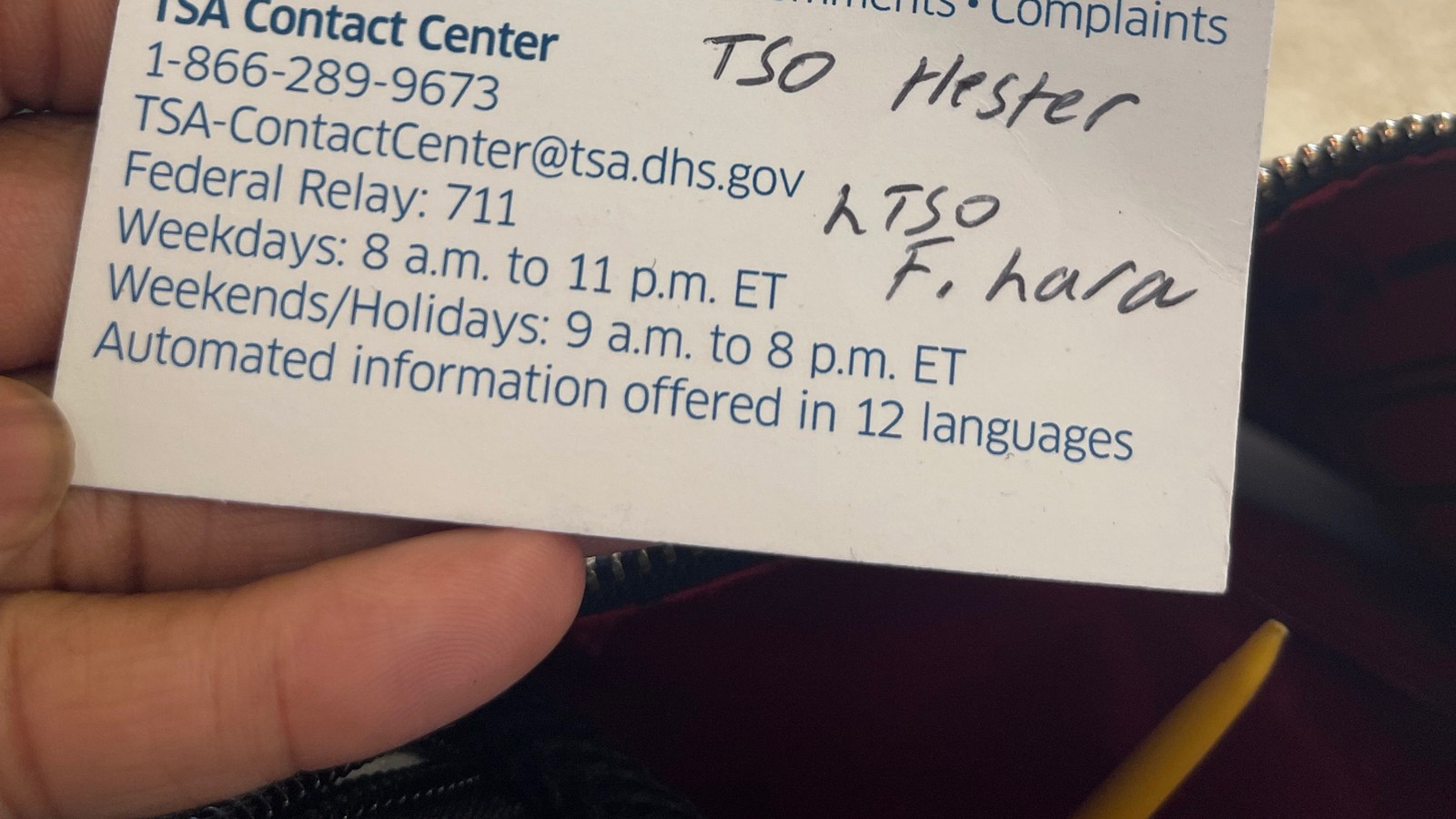
I contacted TSA afterward. I was told that what those employees did fell outside of TSA policy. I am not going to put words in the agency's mouth beyond that.
Nothing about it resembled a normal inspection. It started and stopped based on whether or not someone was watching.
Why Documentation Matters
I am telling this story because of what could have happened next. If jewelry had gone missing in that bag, the first question anyone would have asked me is what was in it and what it was worth. If you cannot answer that on paper, you are starting from behind.
This applies to everyone who travels with valuables, not just jewelers. Before you get on a plane with something that matters, you should have three things.
Proof of Purchase
A receipt or invoice that identifies the piece, names the seller, and states the purchase price. It should describe the item well enough that no one has to guess which ring or chain you are talking about.
Proof of Payment
A record that matches the receipt. A bank statement, a card transaction, a cancelled check, a wire confirmation, or a digital payment record. If you paid cash, the receipt needs to state plainly that cash was received.
Professional Appraisal
A detailed appraisal with photographs, identifying characteristics, metal and gemstone information, condition, and appraised value. This is the document that turns "my earrings" into a described, valued item.
Keep digital copies somewhere other than the bag carrying the valuables. Cloud storage and an email to yourself both work. Documentation that travels inside the same bag as the jewelry protects nothing.
If something is lost or you suspect it was stolen, preserve everything right away. Video, photos, receipts, appraisals, the police report, the incident report, and every piece of written communication about it. Do it while the details are fresh and while the records still exist.
None of this guarantees that an insurance claim will be approved or paid. What it does is make ownership and value much easier to establish when an investigation or a claim is underway, and that difference is often everything.
What I Keep Coming Back To
Had I not been watching my bag, this story ends somewhere very different, and I would be the one trying to prove what I lost.
I have spent my career around this. As a Graduate Gemologist, a jeweler, and a jewelry appraiser, I look at other people's most valuable pieces every week and I know how thin the paper trail usually is. Protecting jewelry is not something you start doing after it disappears. It starts before you ever leave the house.
Protect Your Investment
Schedule a professional jewelry appraisal through UGA Labs and let us help you begin your Jewelers Mutual insurance application.
UGALabs.com
Instagram: @uga.labs
Applications and coverage are subject to Jewelers Mutual's approval, policy terms and conditions. UGA Labs provides independent jewelry appraisal services and helps clients begin the application process.