Somewhere between a display case and a chain, a new category of fine jewelry showed up this year. It is a gold frame built to hold a graded trading card, and it just won a national design award.
Manny Soin owns Middleton Jewelers in Middleton, Wisconsin. His 19-year-old son Esh Soin runs Esh Cardz, a Pokemon card trading business. Together they built the trademarked Grail Frame, a pendant that encases a graded card in gold set with red rubies and white diamonds, and it took First Place for Best Statement Piece at the 2026 INSTORE Design Awards. INSTORE reported the story and the win on September 11.
What they actually built
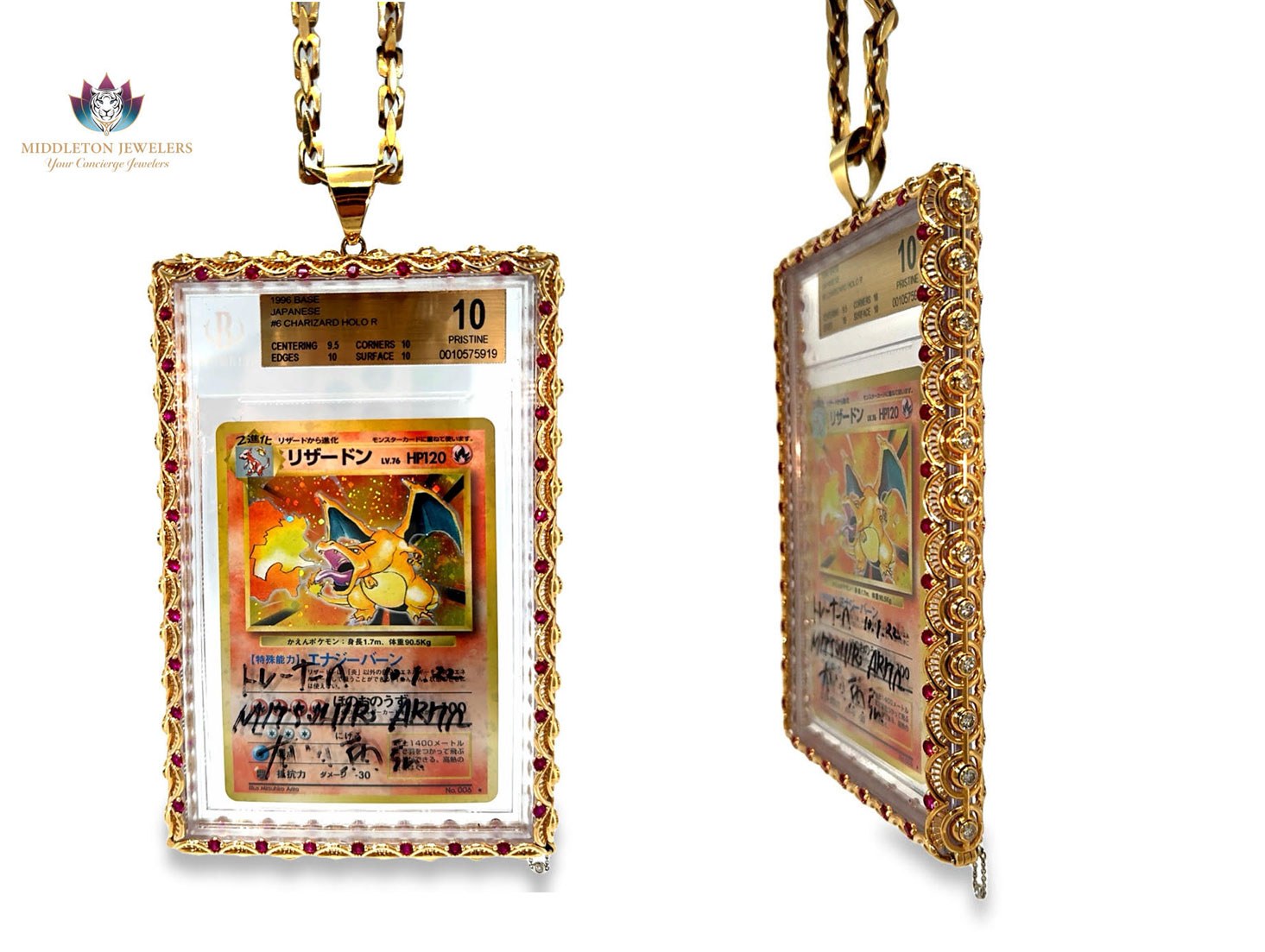
The design brief was harder than it looks. A graded card lives inside a sealed acrylic slab, which means the jeweler is not setting a stone. He is framing a rectangle that already has its own thickness, its own label, and its own visual weight, and he has to do it without hiding the thing everyone came to see.
The Soins chose a gold frame with rubies across the front and Poke Ball inspired details on the sides. Manny told INSTORE the red rubies were picked because Charizard is fiery red and the white diamonds go with anything. That is a designer working from the object outward, which is the correct order of operations. The palette repeats the card. The bezel holds without swallowing.

Look at the side view in the lead image and you can see the real engineering. The frame has depth because the slab has depth. The stone rows run along the edge rather than across the face, so light catches the perimeter and the card stays the subject. There is a small chain and clasp detail at the bottom, which tells you the frame opens. A card this graded is not something you glue shut.
The $4,000 number, said correctly
The figure circulating with this story needs a fence around it. Esh bought a set of cards at a garage sale when he was 14 and learned they were worth about $4,000. That is where his business started. It is not a valuation of the Expedition Charizard now sitting inside the pendant, and the reporting does not establish one. Anyone quoting $4,000 as the value of the framed card is repeating a number that was never attached to it.
Esh found the card after watching the YouTuber Leonhart pull an Expedition Charizard on his channel, then bought it. He and his father went looking for a way to display it, drawing on Logan Paul wearing a Pikachu Illustrator card in a chain. The Grail Frame came out of that search.
Why this is a jewelry story, not a novelty story
I have spent years at the bench and in the Diamond District, and the card world runs on the exact vocabulary my customers use.
A graded card has a certificate from a third-party laboratory. It has a numeric grade broken into subgrades for centering, edges, corners and surface. It has a population report telling you how many exist at that grade. It has a chain of ownership that raises or lowers what a buyer will pay. Swap a few words and that is a diamond report, a cut grade, a rarity argument and a provenance file.
That is why these buyers are easy to talk to and hard to bluff. A collector who has argued about a 9.5 centering subgrade understands immediately why a VS2 with a feather under the table is not the same as a VS2 with pinpoints off to the side. He also understands that a laboratory's name is part of the value, which is a lesson plenty of jewelry buyers learn late and expensively.
The same instinct that built custom hip-hop jewelry
Hip-hop taught the jewelry trade that people will pay to wear the thing they are proudest of. A pendant of your own logo. Your mother's portrait. Your neighborhood. The point was never the carat weight, it was the specificity.
The Grail Frame is that instinct pointed at a card. Manny described it to INSTORE as an accessory to their lifestyle and talked about wearing your asset. It is a coherent idea. If your identity was built inside a hobby, a generic tennis chain says nothing about you and a framed grail says everything.
What a jeweler should think about before quoting one
If a client walks in with a slab, a few things decide whether the job goes well.
- Measure the actual slab, not the card. Grading companies use different case dimensions and they change over time. A frame built for one holder will not close on another.
- Plan for removal. Cards get regraded, sold and swapped. A frame that traps the slab destroys the client's flexibility and eventually your relationship with him.
- Respect the weight. Gold around a rectangle that size adds up fast, and the chain has to carry it without the pendant swinging like a pendulum. Bail geometry matters more here than on a round pendant.
- Do not overset the face. The card is the gemstone. Stones belong on the border.
- Be honest about wear. This is a statement piece for events, not something to sleep in. Acrylic scratches and scuffs read as damage on a piece people photograph up close.
Middleton Jewelers has begun producing sterling silver and gold versions and, according to INSTORE, has sold orders internationally. Manny says he would not sell the original, calling it a passion piece and the journey with his son.
The takeaway
The collectibles market handed the jewelry trade a fully educated customer who already believes in certificates, condition and rarity, and who already spends real money on objects nobody needs. The Grail Frame did not invent that customer. It just gave him something to wear.
If you are that customer, bring the slab, ask how the frame opens, and ask what the piece weighs before you ask what it costs.