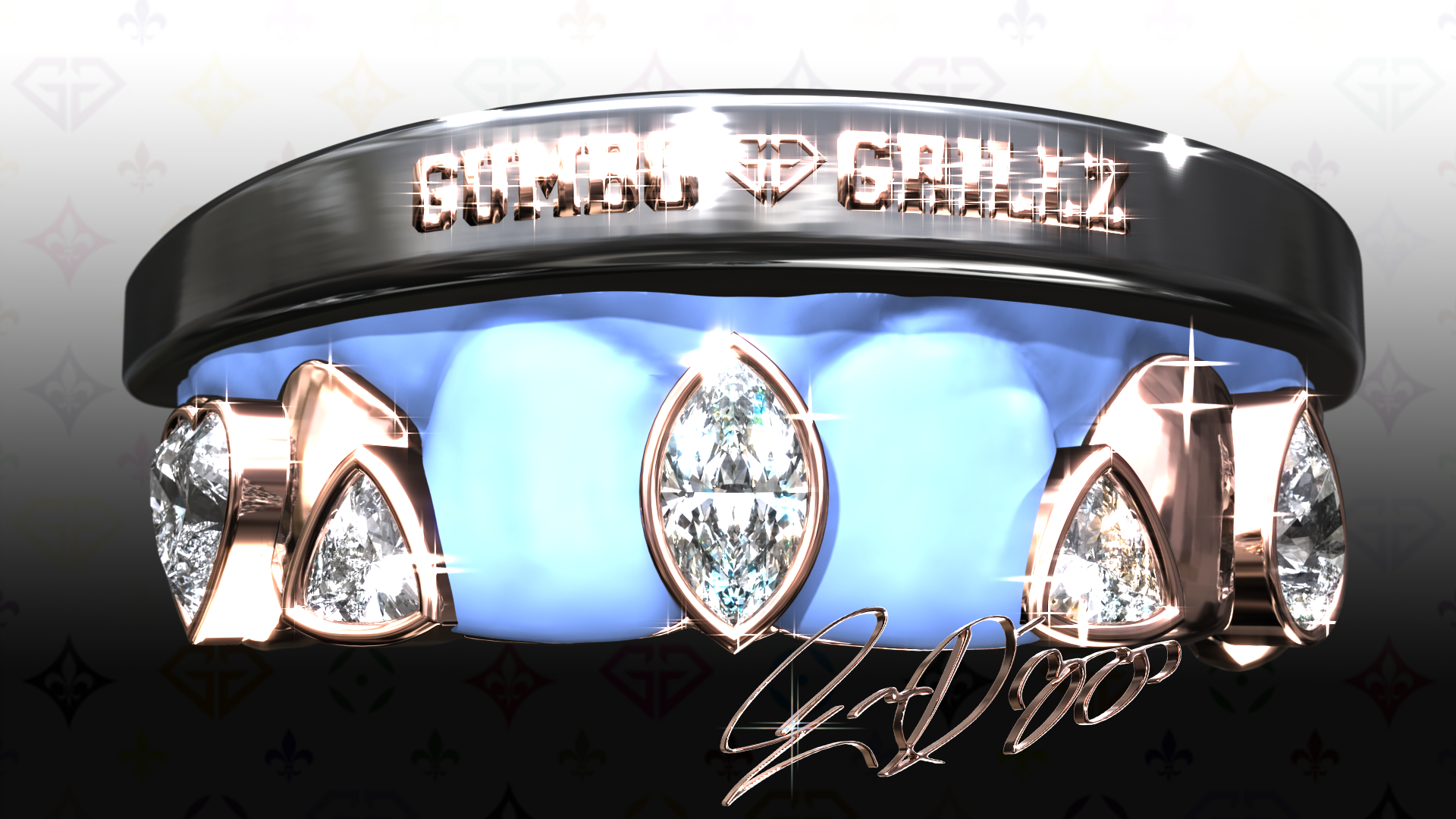
Custom grillz can start around $100 per tooth for a simple, properly fitted 10K gold design and rise to $1,000 to $5,000 or more per tooth for fully diamond-set work. One-of-one sculpted pieces can reach $30,000 to $100,000+.
That is a huge range, but it is not random. The final price comes down to the metal, gold purity, number and size of the teeth, diamond type and quality, stone coverage, setting style, fit, design labor, and the jeweler’s level of craftsmanship.
This guide explains what buyers should realistically budget, what “custom” should include, how to compare quotes, and which red flags usually signal that a cheap price is not the deal it appears to be.
Important: The figures below are planning ranges, not guaranteed quotes. Custom grillz are made individually, and final pricing depends on the exact design, current material costs, tooth size, stone layout, and production requirements.
Grillz Have a History Bigger Than a Trend
Decorative tooth jewelry existed long before modern hip-hop, but the removable grillz recognized today became deeply connected to Black and Latino style, Southern culture, New York jewelry, and hip-hop expression. Gold fronts appeared prominently in music culture in the 1980s and 1990s. Houston became a major center for diamond grillz in the early 2000s, and Nelly’s 2005 song “Grillz,” featuring Paul Wall, helped push the word and the look into the global mainstream.
That cultural history matters. A grill is not simply a costume accessory. At its best, it is personal jewelry made for one person’s smile, taste, story, and budget.
What Is a Custom Grill?
A custom grill is a removable piece of oral jewelry made to fit over one or more specific teeth. The process normally begins with a dental impression or digital scan. A model of the teeth is then used to design, cast, finish, and, when requested, set the piece with stones.
A true custom grill should not be confused with:
- A universal or “one-size-fits-most” grill
- A bend-to-fit fashion accessory
- Gold-plated base metal
- A temporary costume piece
- Permanent crowns or dental restorations
Permanent gold or diamond teeth require dental treatment and belong under the care of a licensed dentist. A removable grill should not require a jeweler to file, drill, reshape, or permanently alter natural teeth.
The Quick Answer: What Should You Budget?
The table below covers a typical single arch, meaning the top or the bottom. A top-and-bottom order will cost more, but it may not be exactly double because design and setup costs vary.
- Grillz Tier: Plain 10K gold; Planning Range Per Tooth: $100 to $150; Typical 6 to 8 Tooth Arch: $600 to $1,200
- Grillz Tier: Plain 14K or 18K gold; Planning Range Per Tooth: $150 to $250+; Typical 6 to 8 Tooth Arch: $900 to $2,000+
- Grillz Tier: Gold with diamond accents; Planning Range Per Tooth: $200 to $750+; Typical 6 to 8 Tooth Arch: $1,200 to $6,000+
- Grillz Tier: Fully iced or pavé diamond; Planning Range Per Tooth: $1,000 to $5,000+; Typical 6 to 8 Tooth Arch: $8,000 to $40,000+
- Grillz Tier: Bespoke sculpted work; Planning Range Per Tooth: Custom quote; Typical 6 to 8 Tooth Arch: $30,000 to $100,000+
The fastest way to get an accurate quote is to provide the jeweler with:
- The number of teeth
- Top, bottom, or both
- Gold karat and color
- Plain gold, diamond accents, or full coverage
- Preferred diamond type
- Reference photos or a sketch
- Your deadline
- Any crowns, veneers, implants, missing teeth, or recent dental work that may affect the fit
Why Two Grillz With the Same Number of Teeth Can Cost Completely Different Amounts
“Six teeth” does not describe enough to price a custom grill accurately. Six plain 10K caps and six fully flooded diamond teeth are different products, even though they cover the same number of teeth.
The main pricing factors are below.
1. Gold Karat and Metal Content
Karat describes the proportion of pure gold in the alloy.
- Gold Purity: 10K; Approximate Pure Gold Content: 41.7%; General Appearance and Budget Position: Most affordable common gold option; lighter gold tone
- Gold Purity: 14K; Approximate Pure Gold Content: 58.3%; General Appearance and Budget Position: Rich color with a mid-range price
- Gold Purity: 18K; Approximate Pure Gold Content: 75%; General Appearance and Budget Position: Highest gold content of these three; richer color and higher material cost
All three are real gold alloys. The right choice depends on budget, color preference, design, and the jeweler’s recommended construction.
Do not rely on the phrase “solid gold” alone. Ask for the exact karat, whether any surface plating is used, and what metal disclosure will appear on the receipt or invoice. Also ask whether the quote includes the entire piece, the fitting process, and any remake or adjustment policy.
Yellow, White, or Rose Gold
Gold color also affects the alloy and production process.
- Yellow gold gives the most traditional gold appearance.
- White gold creates a cooler, bright-white look.
- Rose gold gets its warm pink tone from the alloy mixture.
A mixed-metal design, such as white gold teeth with rose gold borders, may cost more because it requires additional design, assembly, and finishing.
2. The Number, Size, and Shape of the Teeth
A price per tooth is useful for estimating, but it is not a perfect formula.
Front teeth, canines, and premolars have different widths, curves, and surface areas. A wide central tooth may require more metal and more stones than a narrow lateral tooth. A fang, extended canine, or sculpted tooth also requires more design and finishing than a basic cap.
Ordering more teeth may reduce the average price per tooth because some setup work is shared across the piece. The total price still increases as the set becomes larger.
3. Plain Gold, Open Face, Cuts, or Sculpted Design
The design style changes the labor.
Plain Gold Caps
Plain caps are usually the most affordable custom option. The final result still depends heavily on the fit, thickness, polish, contours, and finish.
Open-Face or Window Grillz
Open-face designs expose part of the natural tooth through a shaped opening. They require deliberate spacing and clean borders. A poorly made open face can look uneven even when the gold itself is real.
Diamond Cuts and Textured Gold
Diamond-cut patterns, faceting, engraving, and surface textures can create more light play without adding gemstones. They cost more than a basic polished surface because each tooth requires additional finishing.
Fangs and Extended Canines
Fangs change the silhouette of the smile and may require more metal, more sculpting, and extra attention to comfort and bite clearance.
Sculpted or Character Grillz
Letters, logos, flames, faces, symbols, three-dimensional forms, and one-of-one artwork require custom modeling and significantly more bench work. These designs are closer to wearable sculpture than standard caps.
4. Lab-Grown Diamonds, Natural Diamonds, Moissanite, and CZ
These materials should never be treated as interchangeable.
Lab-Grown Diamonds
Lab-grown diamonds are real diamonds created in a controlled laboratory environment. They have essentially the same chemical, physical, and optical properties as natural diamonds, but a different origin. They generally allow a buyer to achieve greater coverage or higher visual quality for a lower stone budget than comparable natural diamonds.
Natural Diamonds
Natural diamonds formed in the earth and usually carry a higher material price. The cost depends on size, shape, color, clarity, cut quality, matching, and availability.
Moissanite and Cubic Zirconia
Moissanite and cubic zirconia can resemble diamonds, but they are diamond simulants, not lab-grown diamonds and not natural diamonds. They have different optical and physical properties.
A written quote should state clearly whether the stones are:
- Natural diamonds
- Lab-grown diamonds
- Moissanite
- Cubic zirconia
- Another gemstone or simulant
The word “VVS” does not tell you the full story by itself. It should not replace disclosure of the stone type, total estimated carat weight, color range, clarity range, shapes, and setting style.
5. Diamond Size, Shape, Quality, and Coverage
The presence of diamonds is only the beginning of the quote.
Stone Coverage
Common coverage levels include:
- One or two accent stones
- Partial pavé
- Half coverage
- Full pavé or “flooded”
- Diamond borders
- Diamond spacers
- Mixed plain-gold and diamond teeth
More coverage means more stones and more setting labor.
Stone Size
Very small melee can create a continuous pavé surface. Larger stones require more precise spacing and may increase the stone cost quickly.
Stone Shape
Round stones are common because they work efficiently in pavé layouts. Baguettes, emerald cuts, princess cuts, marquise cuts, and custom-shaped stones can raise the price because matching and setting them is more complex.
Diamond Matching
A luxury set should look intentional across the smile. Stones that vary noticeably in color, brightness, or size can make a finished piece look patchy. Matching is part of the cost.
6. Stone-Setting Labor
A fully iced grill is not priced only by adding the value of the diamonds. Each stone must be placed, aligned, secured, and finished.
Depending on the design, the jeweler may use pavé, bead setting, prongs, channels, bezels, or a combination. The work must look even from the front while remaining smooth and wearable around the edges and interior.
Hand setting can represent a major portion of the final price. A low stone price does not compensate for uneven rows, weak settings, rough metal, or stones placed too close to an edge.
7. The Impression, Scan, and Fit
The fit is one of the most important differences between custom jewelry and a costume grill.
The production model must capture the shape and position of the teeth accurately. A poor impression can produce a piece that rocks, pinches, rubs the gums, interferes with the bite, or does not seat fully.
A legitimate quote should explain:
- Whether the fitting is in person or completed with a mold kit
- Whether a digital scan is accepted
- What happens if the impression is unusable
- Whether a second impression is included
- What the adjustment or remake policy covers
- How long the jeweler keeps the model or scan
- Whether a new impression will be required for future orders
A grill that fits the model perfectly can still become uncomfortable if the mouth has changed. New dental work, orthodontic movement, gum changes, crowns, veneers, implants, chipped teeth, or tooth loss may require a new impression.
8. CAD, Wax, Casting, Assembly, and Finishing
A custom grill may pass through several production stages:
- Consultation and design approval
- Dental impression or scan
- Working model
- CAD or hand-sculpted design
- Wax or resin pattern
- Casting
- Metal cleanup and assembly
- Stone setting
- Polishing and finishing
- Final fit review
A simple design may use an established workflow. A one-of-one sculpted set may require multiple design revisions, prototypes, or separate components. That additional development time belongs in the quote.
9. Turnaround Time and Rush Work
Custom grillz are not regular inventory. Current sellers quote production windows ranging from roughly two to eight weeks, with plain gold designs often completed faster than heavily diamond-set or sculpted work.
The stated turnaround should begin from a clearly defined point, such as receipt of an approved impression, design approval, deposit, or final payment. Shipping time is separate.
Before paying, confirm:
- When the production clock starts
- Whether the estimate includes shipping
- Whether design revisions pause the timeline
- Whether rush service is available
- Whether a missed event date changes the refund or cancellation policy
10. The Jeweler’s Experience and Quality Control
The cheapest quote may exclude the work that makes the piece look finished.
Quality control includes:
- Accurate fit
- Balanced tooth proportions
- Clean gumline edges
- Smooth interior surfaces
- Consistent metal thickness
- Secure stone setting
- Even spacing
- Proper polishing
- Design symmetry
- Written material disclosure
- A clear remake or adjustment policy
A jeweler who understands gemology, CAD, fabrication, and stone setting can evaluate more than the appearance of the final photograph. That technical knowledge matters when the design combines small dimensions, curved surfaces, precious metal, and hundreds of stones.
Why a $70 Grill May Not Be the Bargain It Appears to Be
A very low advertised price is not automatically fraudulent, but it may not include what the buyer assumes it includes.
A $50 to $70 listing may refer to:
- One tooth rather than a full set
- Sterling silver rather than gold
- Gold plating over another metal
- A lightweight or extremely thin piece
- A premade universal fit
- A deposit rather than the full price
- A starting price before the mold, shipping, design, or stones
- A promotional price with limited options
Do not make the decision from the headline price alone. Ask for the complete cost in writing and confirm the metal, karat, number of teeth, fit method, stones, turnaround, shipping, and remake policy.
What a Written Grillz Quote Should Include
Before paying a deposit, the quote or invoice should identify:
- Number and location of teeth
- Top, bottom, or both
- Gold karat and color
- Whether the piece is plated, hollow, or otherwise constructed in a special way
- Plain, open-face, cut, sculpted, or diamond design
- Natural or lab-grown diamonds, or the exact simulant
- Estimated total diamond weight when applicable
- Diamond color and clarity range when represented
- Stone shapes and approximate sizes
- Fitting method
- Production timeline
- Shipping or pickup terms
- Deposit and payment schedule
- Cancellation policy
- Adjustment, repair, and remake policy
- Care instructions
- Any warranty limitations
If a major feature was promised in a direct message, make sure it appears on the final invoice.
Common Red Flags
Be cautious when a seller:
- Refuses to disclose the gold karat
- Uses “gold” when the item is only gold-colored or plated
- Calls moissanite or CZ “diamonds”
- Uses “VVS” without stating the stone type
- Advertises a universal piece as fully custom
- Tells you to glue the grill to your teeth
- Offers no written design or order details
- Cannot explain the adjustment or remake policy
- Uses another jeweler’s photos
- Promises an unrealistic turnaround without explaining the process
- Wants to file or alter your natural teeth
- Uses “GIA certified” to imply that GIA approved the jeweler, business, or grill
Where Grillz by Diggs Fits
Grillz by Diggs is positioned in the luxury custom category: real gold, real lab-grown diamonds, custom-fit production, and design informed by gemology, CAD, bench work, and pavé setting.
The correct credential language is:
Designed and quality-controlled by Miss Diggs, a GIA Graduate Gemologist.
GIA does not “certify” jewelers, jewelry businesses, grillz, or diamonds. Individual stones may be accompanied by laboratory reports when applicable, but the business and finished grill should not be marketed as “GIA certified.”
The Grillz by Diggs material standard is also direct: no moissanite and no cubic zirconia represented as diamond. Any laboratory-grown diamond should be disclosed clearly as laboratory-grown.
How to Care for Removable Grillz
Grillz sit in an environment where food, plaque, and bacteria can collect. Care is part of ownership.
- Brush and floss your natural teeth before wearing the grill.
- Remove removable grillz before eating.
- Limit the amount of time they remain in the mouth.
- Clean the piece after wear.
- Use only a cleaner intended for the specific metal, stones, and removable oral jewelry.
- Rinse the piece thoroughly before reinserting it.
- Never put household jewelry cleaner, glue, or another unsafe chemical in your mouth.
- Store the grill in a clean, protective case.
- Stop wearing it if it causes pain, bleeding, swelling, persistent pressure, or gum irritation.
- Keep regular dental appointments.
A removable grill is jewelry, not a substitute for dental treatment. Anyone with cavities, gum disease, loose teeth, braces, recent dental work, or unexplained mouth pain should speak with a dentist before wearing one.
Frequently Asked Questions
How much do six gold teeth cost?
A six-tooth plain 10K gold set may budget around $600 to $900, while 14K or 18K can move closer to $900 to $1,500+. Diamond accents, sculpting, or heavier construction increase the quote.
How much do eight gold teeth cost?
A plain eight-tooth 10K arch may budget around $800 to $1,200. A plain 14K or 18K arch may start around $1,200 and rise with weight, color, design, and finishing.
How much are fully iced diamond grillz?
A six-to-eight-tooth fully iced arch can range from roughly $8,000 to $40,000+. Larger stones, custom shapes, natural diamonds, complex settings, and sculpted metal can move the price well beyond that range.
Are lab-grown diamonds real diamonds?
Yes. Lab-grown diamonds have essentially the same chemical, physical, and optical properties as natural diamonds. Their origin is different, and they must be disclosed as laboratory-grown.
Is moissanite a lab-grown diamond?
No. Moissanite is a separate gemstone and a diamond simulant. It is not a natural diamond or a lab-grown diamond.
Is 10K, 14K, or 18K best for grillz?
There is no universal best choice. 10K is the most budget-friendly of the three. 14K provides a higher gold content and richer color. 18K contains the most gold and carries the highest material cost. Construction quality and fit still matter more than karat alone.
Can I eat while wearing grillz?
Removable grillz should be taken out before eating. Food and debris can become trapped between the grill and the teeth.
Can grillz damage teeth?
Poor fit, prolonged wear, inadequate cleaning, and trapped food or plaque can irritate tissue and contribute to enamel wear, decay, or gum problems. Long-term safety has not been established. A dentist should evaluate individual oral-health concerns.
How long do custom grillz take?
Many sellers quote roughly two to eight weeks after receiving an approved impression or scan. Complex diamond and sculpted designs may take longer. Use the timeline written into your own order rather than relying on a general estimate.
Can a grill be adjusted if it does not fit?
Sometimes. Minor adjustments may be possible, but a poor impression or major fit problem may require a remake. The jeweler’s written adjustment and remake policy should explain who pays for a new impression, shipping, labor, or materials.
Can I use an old mold for a new set?
Possibly, but a new mold or scan is safer when the teeth or gums may have changed. Dental work, orthodontic movement, tooth damage, or gum changes can affect the fit.
Are custom grillz refundable?
Policies vary. Because custom grillz are made for one person’s teeth, many deposits and completed orders have restrictions. Read the cancellation, remake, and refund policy before paying.
The Bottom Line
The price of custom grillz is not determined by tooth count alone. A proper quote reflects the gold, weight, design, diamonds, setting, fit, labor, and quality control required to build the piece.
For a simple real-gold set, plan for hundreds to a few thousand dollars. For full diamond coverage, plan for thousands to tens of thousands. For a sculpted one-of-one commission, the budget can reach six figures.
The right question is not only, “How cheap can I get it?”
Ask:
- What exactly is the metal?
- What exactly are the stones?
- How will it be fitted?
- Who is making it?
- What happens if it does not fit?
- What is included in the final price?
- Will the finished piece still look and wear the way I expect after the photograph is taken?
That is how you compare custom grillz honestly.
Request a Custom Grillz Quote
For the most accurate estimate, submit:
- Top, bottom, or both
- Number of teeth
- Gold karat and color
- Plain gold, diamond accents, or full pavé
- Lab-grown or natural diamonds
- Reference images
- Target completion date
- City or shipping location
Final pricing is confirmed after the design and fitting requirements are reviewed.
Written by Miss Diggs, GIA Graduate Gemologist, jewelry CAD designer, bench jeweler, and pavé diamond setter.
Dental disclaimer: This guide provides general jewelry, pricing, and care information. It is not dental advice. Consult a licensed dentist about your oral health and whether removable oral jewelry is appropriate for you.