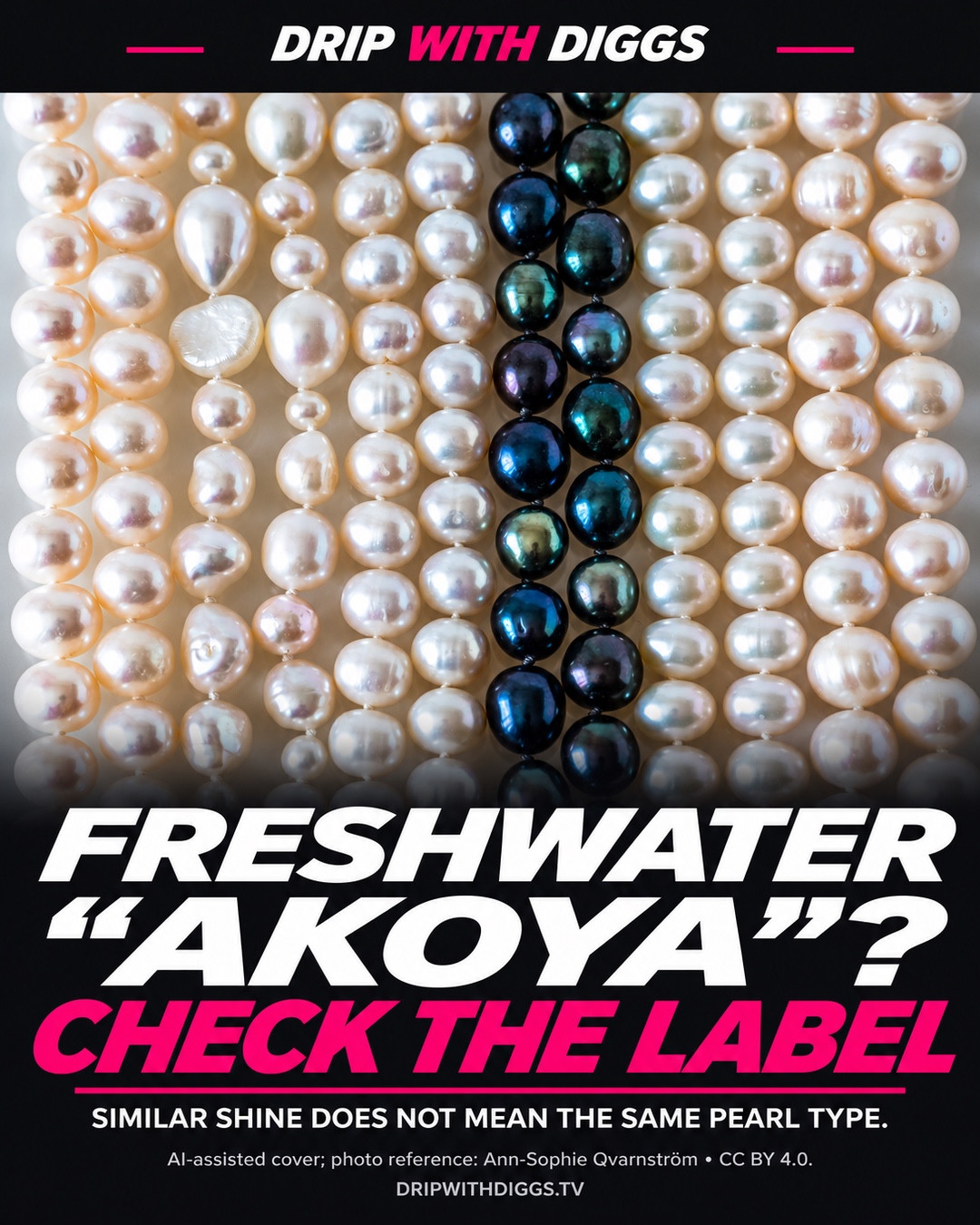
A strand of bright, round white pearls can look beautiful at an attractive price. Then the listing calls them “freshwater Akoya,” and the buying decision gets confusing. Are they freshwater pearls, or are they Akoya?
GIA addressed that label in January 2026: the freshwater pearls being sold under that description are not Akoya pearls. The problem is the identification, not whether the pearls deserve to be worn.
Similar shine, different identity
Akoya cultured pearls grow in saltwater mollusks. The freshwater pearls described in GIA’s warning grow in a different environment and different mollusks. Newer bead-nucleation methods can produce freshwater pearls with round shapes and bright luster that resemble Akoya pearls. That resemblance does not change their identity.
GIA also flags labels such as “baby Akoya” and “Chinese Akoya” when used for these freshwater products. The concern is specifically the misleading use of Akoya for freshwater pearls. Genuine Akoya pearls can also be cultured in China, so the country name alone does not establish a problem. GIA explains the distinction.
Decide what the quality is worth to you
Freshwater pearls have plenty to offer on their own terms. GIA’s pearl buying guide points to their substantial production and the availability of attractive, affordable examples, particularly off-round pearls. A truthful freshwater description gives you a clearer starting point for comparing similar jewelry.
Then examine the qualities you will actually live with. GIA evaluates pearls through seven value factors: size, shape, color, luster, surface, nacre and matching. Look at the sharpness of reflections, visible surface characteristics and how consistently the pearls work together across a strand or pair of earrings. For shoppers who love irregular shapes, a well-formed baroque pearl can be desirable in its own right.
My advice is to separate two questions: Do you like the pearls? And does the seller’s description accurately identify them? You should be able to answer both before paying.
Ask for a clear description
Ask the seller to identify the pearls as freshwater or saltwater and state what documentation supports the description. If a laboratory report accompanies the jewelry, read its actual findings. GIA’s Pearl Identification Report records information including the environment, mollusk and detectable treatments, alongside descriptive details.
You can choose freshwater pearls because you love their look and price. You should never have to buy them under a confusing name.
About the author
Erica Diggs is a GIA Graduate Gemologist, bench jeweler, GIA-trained 3D CAD jewelry designer and diamond setter. She is the founder and editor of Drip With Diggs.