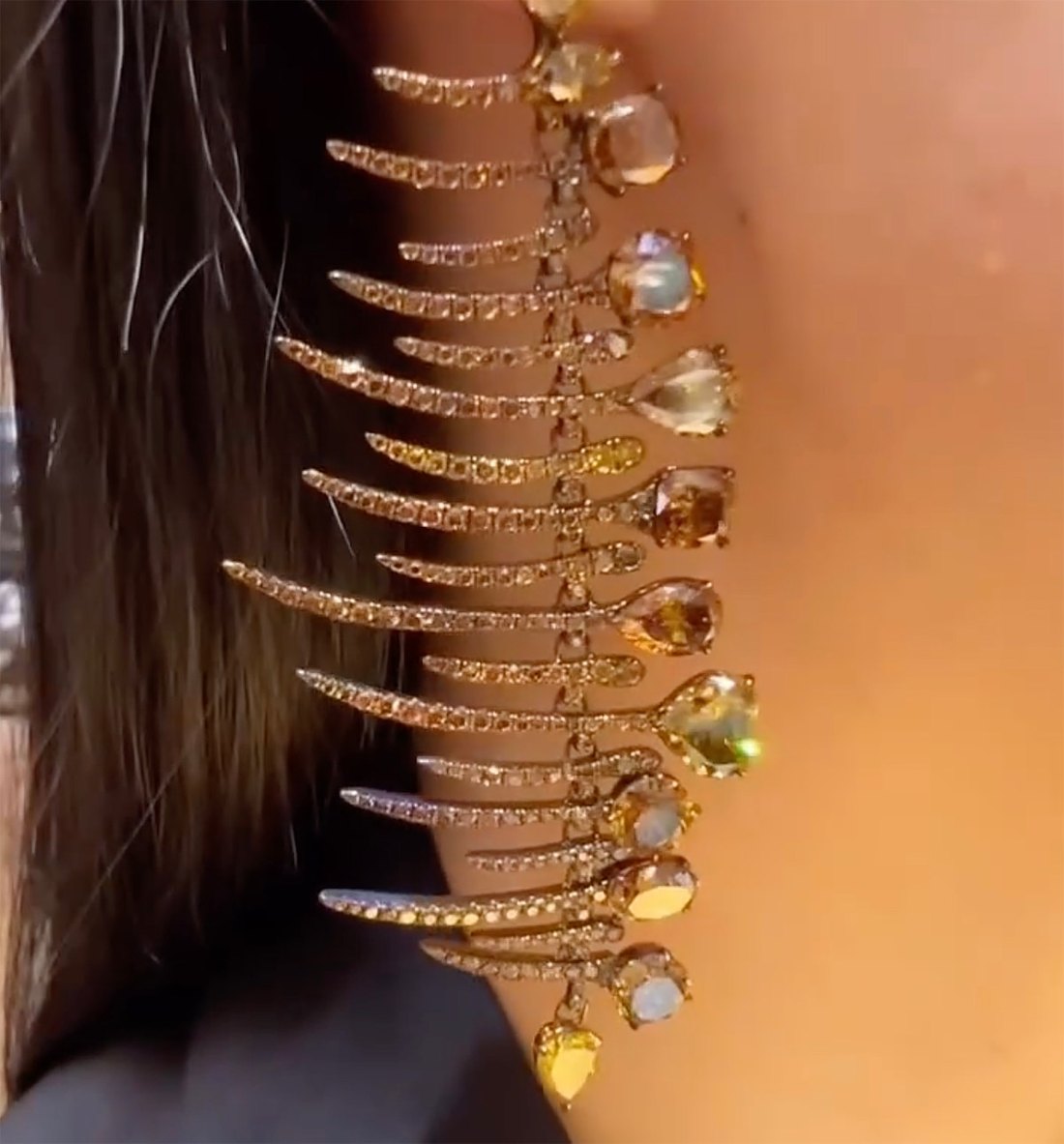
The easy move at that level is a pair of diamond chandeliers. Big, white, expensive, photographs fine, tells you nothing.
Beyoncé did not make the easy move.
For her 45th birthday weekend in London, she wore Glenn Spiro "Fishbone" chandelier ear clips set with natural spessartite garnets and diamonds. Reporting on the look describes the design as built to read like a fishbone, with spessartite garnets alongside yellow, orange and white diamonds.
No carat weight was disclosed. No valuation was disclosed. I want to be direct about that, because within a day of any Beyoncé jewelry appearance somebody publishes a number. Nothing in the accessible reporting supports one, so I am not going to invent one for traffic.
What is worth talking about is the stone.
What spessartite actually is
Spessartite, sometimes written spessartine, is a member of the garnet family. Chemically it is a manganese aluminum garnet, and its color range runs from orange through reddish orange, with the yellowish orange material often marketed as mandarin garnet when the saturation is strong and the tone is bright.
A few things I tell clients about it in the shop.
It is a singly refractive stone with a high refractive index, which is why good spessartite has real snap rather than the sleepy look many orange stones have. Refraction is doing the work, not treatment.
Fine spessartite is usually free of the heat treatment conversation entirely. Unlike a lot of the colored stone market, you are typically looking at natural color. That is a legitimate selling point and it is verifiable.
It also tends to carry visible inclusions. Wavy or feathery inclusions are common in the material, and in strong stones a slight haze is normal rather than a defect. Judge spessartite on color first and on eye clean perfection second. That is the opposite of how most people were taught to shop for diamonds.
Hardness sits around 7 to 7.5 on the Mohs scale. Durable enough for earrings and pendants, less forgiving in a ring worn every day.
Why orange was the right call
Look at the styling logic. The evening was bronze and gold: a sheer golden bronze look, a gold bag, metallic gold nails.
If you put white diamond chandeliers into that palette, the earrings compete with the metallics and lose. White reads cool against warm gold. It flattens. You end up with a lot of sparkle that does not belong to the outfit.
Saturated orange does the opposite. It sits inside the warm family and pushes the bronze forward instead of fighting it. The stone becomes the reason the gold looks deliberate rather than the reason the gold looks busy.
And with diamonds mixed in, you get both jobs handled: the garnets carry color and body, the diamonds carry the light return along the spines. That is why the piece photographs as movement rather than as a block of white.
This is the part of high jewelry styling that people who only follow carat weight miss entirely. The most expensive option is frequently the least interesting one.
The Fishbone as a construction problem
I look at chandelier earrings as a bench problem before I look at them as a fashion moment, because they are one of the hardest things to build well.
A fishbone silhouette means a central spine with paired ribs stepping down in graduated lengths, and drops hanging at the ends. Every one of those ribs is set with small stones, so every one of them has to be individually finished, and they all have to hang in plane with each other. If one rib sits a degree off, the whole piece looks broken from the front.
Then there is weight. The drops carry stone at the far end of a long lever. An earring like this has to move when the wearer moves, hold its shape when she stops, and still not tear at the ear. Clip construction, as used here in ear clips rather than posts, is a real engineering choice at that scale. It distributes load across the lobe instead of concentrating it in a single piercing, which is exactly why serious high jewelry houses still build clips for pieces this long.
And the stone selection is its own labor. Matching a run of spessartite across graduated positions means the cutter and the setter had to find material that agrees in tone and saturation at multiple sizes. Anyone who has tried to match a suite of colored stones knows that job is harder than finding one large one.
If you like the look
You do not need a red carpet budget to use this idea.
Spessartite is available in commercial sizes at prices far below fine ruby or fancy colored diamond, and the color does more for warm skin tones and gold jewelry than a white stone of the same size. Buy for saturation and brightness rather than for size, look at the stone under more than one light source, and accept some inclusions in exchange for color.
Set it in yellow or rose gold. White metal drains warm stones. If it is going in a ring rather than earrings, choose a protective setting and treat it as a piece you take off for cleaning and manual work.
For care, this is simple. Warm water, a drop of mild dish soap, a soft brush around the settings, rinse, dry fully. Skip the ultrasonic machine on a stone with visible feathers, because vibration finds inclusions. Store it away from harder stones so nothing scratches the surface.
The takeaway
There will be a hundred posts about the outfit. The jewelry story is smaller and better: at a moment when she could have worn anything, Beyoncé wore natural orange garnet, and the color choice was more sophisticated than the diamond version would have been.
Color is a decision. White is a default.