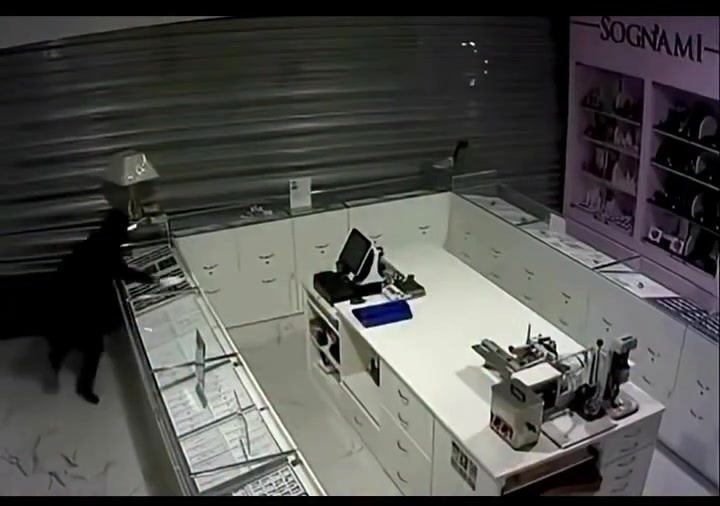
The showroom is visible before it vanishes. Glass counters frame a central work area. Several people move through the landscape CCTV view. Then white fog pours across the room, reducing bodies to silhouettes and swallowing the display cases.
A video circulating online shows a jewelry showroom disappearing behind a wall of white fog as several people move through the room. The clip has been presented as a security-system success story, but its origin remains unclear. We have not confirmed the store, date, system brand, or whether the footage captures an actual robbery, a staged demonstration, or a marketing video. What is clear is that the technology shown is designed to do one thing: take away an intruder’s visibility.
The serious question is not whether a viral video proves a theft was stopped. It is whether removing visibility can buy a jeweler time, and whether that delay can be engineered without compromising the people inside. Security fog is a real category with an established history. Its value belongs in a security assessment, not in the certainty of a caption.
What the clip shows
The supplied 32.8-second recording looks down into a jewelry showroom. Multiple figures move between glass counters and the central area. A dense white plume spreads rapidly, and visibility deteriorates until most of the room is obscured. The image offers less and less information about where people are or what they are doing.
The supplied excerpt ends while heavy fog still obscures the showroom. It does not show a clearly documented return to normal visibility. That matters: neither an exit nor the condition of the stock can be established from the obscured view. The visible sequence is evidence of rapid obscuration, not a verified account of an arrest, escape or prevented loss.
Video source: supplied social-media recording. Creator and rights holder not identified.
Security fog is a real anti-theft category
Often called security fog or anti-theft fog, these systems release an obscuring cloud into a protected space. The idea predates today’s social-media circulation. JCK’s June 1999 reporting described SmokeCloak in jewelry-store security coverage, including its alarm connection and the need to notify emergency services. That is historical context, not breaking news or a current installation specification.
SmokeCloak, Smoke Screen, DensityUSA and PROTECT Global are examples of vendors in the category. Their published material pitches fog as a way to protect stock during the interval before a response arrives. Smoke Screen describes integration with existing retail alarms, while DensityUSA claims near-zero visibility in seconds. PROTECT markets its systems specifically to jewelers. Those are vendor claims; none identifies the equipment in this clip or establishes what happened inside this showroom.
How it works
The Security fog section of official guidance hosted by ProtectUK describes glycol-based liquid blends being rapidly heated to produce vapor that disperses into an obscuring cloud. The Fire Protection Association’s specialist guidance explains the process more precisely: fluid passes through a heating block, vaporizes and condenses on release into dense white fog.
Activation can come from an intrusion alarm or a panic/hold-up signal, depending on the system and its approved design. Confirmed intrusion logic can require more than one detection signal before discharge. A staff-operated hold-up application has different demands from an empty store’s overnight burglary protection; the trigger, direction of discharge and escape routes must be designed for that use.
The purpose is active delay and loss prevention, not punishment. An alarm communicates that something may be wrong. Fog changes what can be seen while the response is still on its way. Vendors commonly promise obscuration within seconds, but official guidance also makes clear that effectiveness depends on the equipment, number and location of units, and size of the space. No advertised timing is a guarantee for this recording.
Why jewelers are looking at it
Jewelry retail depends on visibility. Customers need to inspect workmanship, stones and settings; staff need to see hands, counters and entry points. An intruder can exploit the same open sight lines to select a target quickly. Fog attempts to interrupt that visual access during the short window in which a fast theft can unfold.
Alarms notify. Cameras document. Dense fog may deny a fast intruder enough visual access to slow the attempt while monitored response procedures take effect. That is the commercial argument behind the category, not proof that every installation will stop a theft. Someone familiar with a layout, a poorly positioned unit or an unsuitable activation sequence can change the outcome.
ProtectUK’s broader physical-security guidance places protective measures within risk assessment and emergency planning. For a jeweler, fog is one layer in that plan. It cannot secure every entry point, protect merchandise already removed, or substitute for people knowing how to respond.
The safety and compliance questions
The ProtectUK-hosted guidance says fog is safe to breathe during limited exposure but may irritate people with respiratory conditions. It also advises taking manufacturer-specific safety advice. That is not a blanket medical assurance, and the product’s fluid information and the actual occupancy of the showroom belong in the assessment.
Obscuration creates its own hazards. Counters, steps and objects on the floor may become difficult to see. Fog can activate smoke sensors and travel through doors, windows and HVAC systems. Normal visibility does not return instantly. Life-safety integration, ventilation review and a plan for clearing the room are therefore part of the installation, not matters to improvise after discharge.
Staff need training for real incidents and false activations. Police and alarm-monitoring teams need to understand that fog may be present. Egress must remain unobstructed, and fire-code requirements must be reviewed with the authority having jurisdiction. No retailer should disable or alter fire detection simply to accommodate a fog generator; the fire and security specialists must resolve that interaction together.
American Gem Society guidance by Jewelers Mutual describes perimeter, area and safe/vault protection, central-station monitoring and the value of a UL-certificated alarm installation where possible. Its controlled-entry guidance emphasizes an operating plan for door buzzers and staff responsibility. Its theft-prevention guidance addresses safes, vaults, reinforced structures and surveillance. Together, those measures underline the point: fog belongs alongside monitored alarms, access control, physical barriers, cameras, secure storage and practiced procedures.
What this clip does not prove
There is no independently verified robbery, store identity, incident date, system brand, police report or loss figure attached to this reporting. Nor does the recording establish that fog stopped a theft. Social-media framing may be promotional. The clip remains an unverified lead into a real technology, rather than a case study with a demonstrated result.
That distinction leaves room for serious evaluation. A compelling demonstration can show a cloud forming. It cannot, on its own, establish safe coverage, reliable triggering, acceptable emergency response or insurance acceptance for another jeweler’s premises.
Questions to ask before buying
The buying conversation should start with the showroom and its risks, not the most dramatic demonstration. The BSI listing for BS EN 50131-8 describes requirements for security fog devices within intrusion and hold-up alarm systems, including performance, testing and guidance on design, installation, operation and maintenance. Ask which edition and requirements apply in the installation’s jurisdiction; a British standard is not a substitute for local approval.
Installer and trigger logic. Is the installer competent and approved for the equipment? What applicable standards and certifications can be documented? Which inputs activate the system, what counts as confirmed intrusion, and how does staff panic activation differ from an overnight alarm?
Coverage and people. What is the measured room volume, and what coverage has been calculated for counters, adjoining areas and open doors? How will staff and customers reach safety? Can a demonstration establish that egress stays usable without exposing occupants to an unassessed risk?
Fire approval and ventilation. Has the fire-code authority or other authority having jurisdiction accepted the proposed arrangement? What happens to smoke detection, HVAC and adjacent occupancies? How is fog cleared, and what inspection or clean-up is required before reopening?
Service and false activation. What are the inspection, testing and fluid-replacement intervals? Who responds to a fault or unintended discharge? How are staff trained, what shuts the system down safely, and how is a false activation reported and investigated?
Response and insurance. How will the fog system communicate with monitored alarms, keyholders and police-response procedures? Has the insurer accepted the specific design in writing? Can the supplier provide relevant installed-site references and witnessed testing rather than relying on a promotional clip?
A layer, not a replacement
The fog in the recording transforms a visible showroom into an obscured space. The business decision behind that effect is less cinematic: whether a professionally designed system can add useful delay while preserving a safe response for staff, customers and emergency services.
Security fog is a serious technology worth evaluating for high-value retailers. It does not replace insurance, monitored alarms, safes, cameras, access control, training or an emergency plan. The strongest security investment is not the one that looks most decisive on a phone. It is the one that works with every other layer when the showroom is no longer under ordinary conditions.