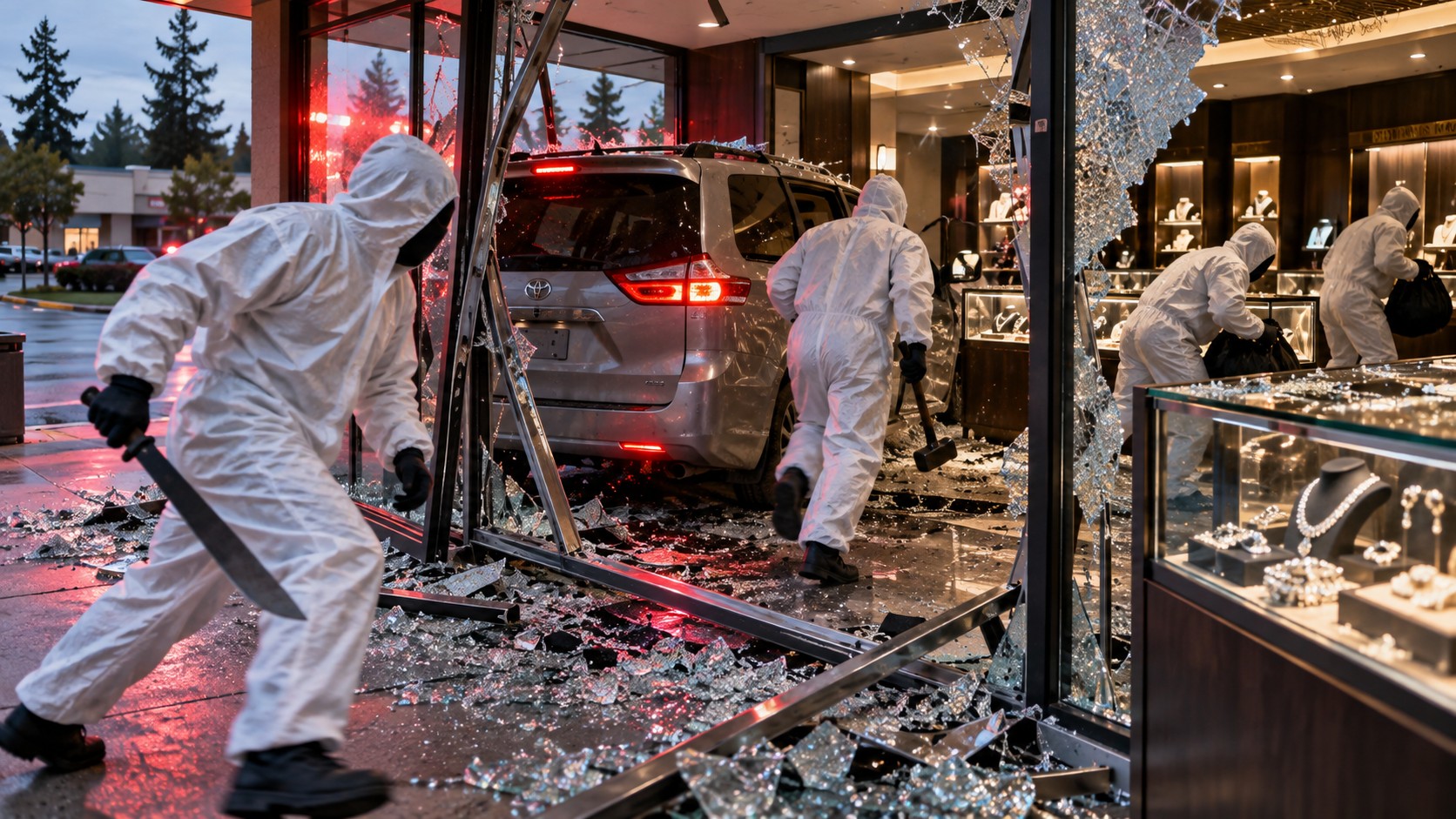
The minivan did not slow down at the curb, and it did not stop at the door.
According to Kent, Washington police, a stolen Toyota Sienna was driven through the entrance of Taj Jewelers on September 12, 2026, while the store was open for business. In the time it takes to hand a customer a ring back across a counter, a retail floor became a crime scene with broken glass, a vehicle inside the threshold and staff who had nowhere obvious to go.
Everything that follows is what police and local reporting have described. No arrests had been announced in the latest reporting reviewed, and nothing here should be read as a finding of fact about any person.
What police say happened at Taj Jewelers
Police said four suspects were involved. They said the vehicle used to breach the storefront was stolen, and that the group wore white Tyvek-style protective suits and gloves. Police said the suspects carried clubs and machetes as they moved through the store.
One employee sustained minor injuries, according to police. The department has not disclosed how much jewelry was taken or what it was worth. Police said the group left the scene in a second stolen vehicle.
KOMO News reported the incident locally on September 14, and the trade publication INSTORE picked it up on September 15. This report was published on September 16. Details in cases like this frequently change as investigators release more information, and figures repeated early are often revised later.
Why the stolen minivan changed the risk
A vehicle used as a battering ram removes the one assumption most retail security is built on, which is that entry happens through a door.
Doors can be locked, buzzed, staffed and monitored. A minivan travelling at even modest speed does not negotiate with any of that. It defeats a locked entrance, the vestibule behind it, and often the fixtures immediately inside, all at once, and it does it in the first two seconds of the event.
The vehicle being stolen matters too. It means the people involved were not risking their own property, and it means the vehicle itself carries little useful ownership trail for investigators. That is one reason a second stolen vehicle for the departure is a familiar pattern in reporting on these cases.
The machetes made this more than property crime
A smash-and-grab at a closed store at three in the morning is a property crime with a glass bill attached. Police describe something different here. Staff and customers were present during business hours, and police said the suspects were carrying clubs and machetes.
Once weapons and people are in the same room, the risk is no longer inventory. It is bodily harm. That single fact should reorder how any jeweler thinks about their own plan, because merchandise is insurable and staff are not replaceable.
Why smash-and-grab protection cannot stop at the display case
Most independent jewelers I talk to think about security in terms of the case. Locked showcases, a safe, a camera in the corner, maybe a pull-down gate at night. Those are worth having. They are also the last layer, not the first.
Where local codes, landlords and permitting allow it, the outer layer is physical: crash-rated bollards or other vehicle barriers, protective planters, curb geometry and parking layouts that keep a car from getting a straight run at the glass. Laminated or security glazing does not make a storefront impenetrable, but it slows a breach and buys seconds. Layered storefront design, meaning an outer barrier, a vestibule, then an interior line, means an intruder has to solve more than one problem.
Then come the parts that protect people rather than product: silent alarms and duress signals staff can reach without announcing themselves, a rehearsed retreat route to a securable back area, and training that tells employees plainly to move away and let insured merchandise go. Nobody on payroll should ever be encouraged to physically confront an armed offender.
After the fact, documentation is what decides how the next year goes. Cloud or off-site video backup so recordings cannot be taken with the recorder. Opening and closing protocols that are never the same two days running. Serial numbers, photographs and current inventory records for every piece on the floor and in the safe. And an insurance review that reflects what is actually in the store now, not what was in it three years ago.
None of this guarantees prevention. Anyone selling you a product that promises otherwise is selling you a story.
What jewelers can learn without blaming the victim
I want to be careful here. Nothing in the reporting reviewed indicates that Taj Jewelers lacked any particular protection, and I am not going to imply it did. A vehicle-based breach during business hours is a scenario that overwhelms plenty of well-secured stores.
The useful response is not judgment. It is to take a case like this and walk your own floor with it. Where could a car reach your glass. Where would your staff go. Who calls whom. Where is your footage stored. When was your policy last read all the way through.
What remains unknown
A great deal. The amount and value of jewelry taken have not been disclosed. No arrests had been announced in the latest reporting reviewed. Investigators have not publicly described a motive, and it is not this outlet's job to guess at one or at anything about who the suspects are.
Final takeaway
An employee walked away with minor injuries, and that is the number that matters most in this case. Everything else in the store was merchandise, and merchandise is the part of a jewelry business that can be replaced.
If you own or run a store, treat this as a drill rather than a headline. Assume the entrance is not the entrance. Assume your people, not your cases, are the thing you are actually protecting.